Age-friendly oral health care: A scoping review and conceptual framework for integrating dentistry into healthy ageing
Article information

Abstract
Purpose
Oral health is increasingly recognized as a key component of healthy ageing, yet it remains insufficiently integrated into age-friendly health systems. To map existing evidence on oral health in older adults and propose a conceptual framework for age-friendly oral health care.
Methods
A scoping review was conducted following Preferred Reporting Items for Systematic reviews and Meta-Analyses extension for Scoping Reviews (PRISMA-ScR) guidelines. A PubMed search identified 708 records (April 18, 2026). After applying filters (last 10 years, ≥ 65 years, human studies), 247 records remained. Following thorough screening, 52 studies were included and thematically analyzed.
Results
The included studies showed consistent associations between oral health and functional outcomes, frailty, and quality of life. Functional oral health, particularly mastication and dentition, emerged as a key determinant of healthy ageing. However, the evidence was fragmented, and no study proposed an integrated framework linking oral health to age-friendly health systems.
Conclusion
The concept of age-friendly oral health care is proposed to bridge this gap and align dentistry with broader ageing frameworks. Establishing this concept may support more coherent policy development and integrated care for older adults.
Introduction
Population aging is a defining demographic transformation of the twenty-first century, placing unprecedented demands on healthcare systems to evolve beyond clinical efficacy toward coordinated, person-centered care [1]. The World Health Organization (WHO) has redefined healthy aging as the preservation of functional ability and well-being rather than the mere absence of disease [2]. This paradigm shift has been operationalized through the Age-Friendly Health Systems (AFHS) initiative and its 4Ms framework (What Matters, Medication, Mentation, and Mobility), which provides a structured approach to aligning care with the needs of older adults [1,3,4].
Despite the rapid adoption of age-friendly principles in general medicine, dentistry remains largely procedure-oriented and fragmented, often isolated from broader geriatric care models [5]. Clinical oral care for older adults, particularly those in long-term care or with functional dependency, is frequently compromised by a lack of integrated routines, time constraints, and insufficient provider confidence [6]. This gap is particularly critical because oral health is closely associated with systemic health, nutrition, and psychological well-being [7]. Furthermore, older adults tend to perceive oral care not merely as a technical service, but in relation to autonomy, trust, and life-course experiences [8,9].
Addressing these challenges requires moving beyond chairside-centered interventions toward a comprehensive system of assessment and support. Persistent barriers—such as mobility limitations, reduced oral health literacy, and cognitive decline—highlight the necessity of multidisciplinary approaches involving caregivers and non-dental professionals [10–12]. In practice, oral care for dependent older adults is often delegated to nursing or caregiving staff; however, such integration remains inconsistent and insufficiently structured [13]. In addition, social and environmental factors, including community structure and access to care, may further influence oral health outcomes in older populations [14]. Nevertheless, many clinicians report uncertainty and insufficient training when managing patients with advanced frailty or cognitive impairment, particularly in relation to the Mentation domain.
In response, the concept of Age-Friendly Oral Health Care (AFOHC) is emerging as a framework to align dental practice with AFHS principles. Rather than defining a new subspecialty, AFOHC emphasizes system-level adaptation, including environmental modification, caregiver engagement, and clinical protocols tailored to varying levels of functional and cognitive capacity. This perspective is consistent with earlier calls for a broader, system-oriented approach to oral health promotion in older adults [15,16].
Accordingly, the aim of this study is to conceptualize an AFOHC framework by adapting AFHS principles to dental settings, with particular consideration of the Korean context. As a society undergoing rapid demographic transition to a super-aged structure, Korea faces a “time-compressed” challenge in which advanced clinical dental capabilities coexist with insufficient system-level readiness for managing frail and cognitively impaired older adults. By proposing a model tailored to such conditions, this study seeks to contribute to a more coherent, equitable, and sustainable oral health care system that recognizes oral health as an essential component of healthy aging.
Materials and Methods
This scoping review was conducted in accordance with the Preferred Reporting Items for Systematic reviews and Meta-Analyses extension for Scoping Reviews (PRISMAScR) guidelines. The study aims to map the evidence on AFOHC and establish its conceptual framework within the broader health system [17].
A systematic literature search was conducted in PubMed on April 18, 2026. The search strategy combined terms related to ageing, oral health, and age-friendly care concepts. The full search string was as follows: (“older adults” OR elderly OR ageing OR aging OR geriatric*) AND (“oral health” OR “oral care” OR dentistry OR “dental care” OR “geriatric dentistry”) AND (“healthy ageing” OR “healthy aging” OR “age-friendly” OR frailty OR “intrinsic capacity” OR “Age-Friendly Health Systems”). Filters were applied for human studies, adults aged ≥ 65 years, English language, and publication years 2016-2026. The search initially yielded 708 records. After applying automated filters for human subjects, age ≥ 65, and a 10-year publication window (2016-2026), 247 records remained. Following a title and abstract screening for conceptual relevance to AFOHC, a final total of 52 studies were included for analysis.
Title and abstract screening were independently conducted by two reviewers to evaluate conceptual relevance to AFOHC. Studies with uncertain eligibility underwent full-text assessment. Disagreements regarding study selection were resolved through discussion and consensus among the authors.
Data were extracted using a structured charting framework. The variables captured included: 1) study characteristics: author, year, country, and study design, 2) context: population and setting, 3) clinical and systemic domains: oral health domains (e.g., oral frailty, mastication), aging-related constructs (e.g., intrinsic capacity), care delivery models, and alignment with age-friendly health frameworks.
A thematic synthesis approach was employed to categorize the findings into five core domains: 1) conceptual frameworks and healthy aging, 2) functional oral health, 3) oral frailty and intrinsic capacity, 4) care delivery and system integration, 5) education and workforce development.
In this framework, “functional oral health” refers primarily to the performance-related aspects of oral function, including mastication, dentition status, and chewing ability, whereas “oral frailty and intrinsic capacity” addresses the broader relationship between oral conditions and systemic ageing processes, including physical frailty, cognitive decline, and reductions in intrinsic capacity. These synthesized findings were ultimately integrated to develop a conceptual model that links oral health to the overarching principles of AFHS.
Results
The initial systematic search of PubMed retrieved 708 records. After applying automated eligibility filters for publication date (2016-2026) and population age (≥ 65 years), 247 records were retained for screening. Following title and abstract screening for conceptual relevance to AFOHC, a final total of 52 studies were included in the review. For studies with uncertain or ambiguous relevance, full-text evaluation was conducted by the authors to ensure appropriate inclusion. Among the 52 included studies, 28 were identified as core studies for the thematic synthesis [18-45], while the remaining studies were classified as supportive studies [46-69]. The detailed selection process is illustrated in the PRISMA flow diagram (Fig. 1).
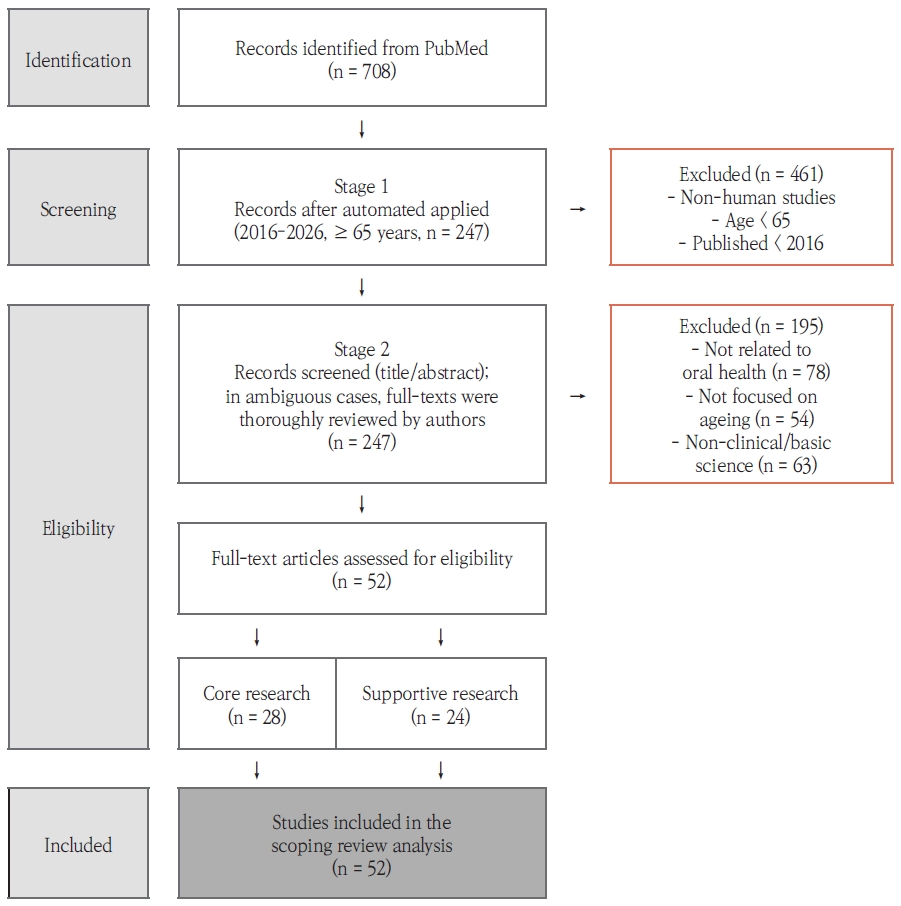
Selection process of articles by PRISMA guidelines.
The included studies (n = 52) exhibited significant methodological heterogeneity, comprising cross-sectional studies, longitudinal cohorts, qualitative research, systematic reviews, and conceptual policy papers. Geographically, the evidence base spanned Europe, North America, and Asia, reflecting a burgeoning global interest in the intersection of aging and dentistry.
From a methodological standpoint, the majority of the literature was observational. A notable paucity of research was observed regarding structured, system-level interventions or the implementation of integrated care models within dental settings.
The thematic analysis identified five dominant domains that characterize the current landscape of AFOHC (Fig. 2). A subset of the literature positioned oral health within the broader paradigm of healthy aging. These studies framed oral health not as an isolated clinical outcome but as a determinant of functional ability and quality of life (QoL) [18,27,42]. However, a significant conceptual gap was identified, as no studies proposed a comprehensive framework integrating oral health into AFHS [23,38,39].
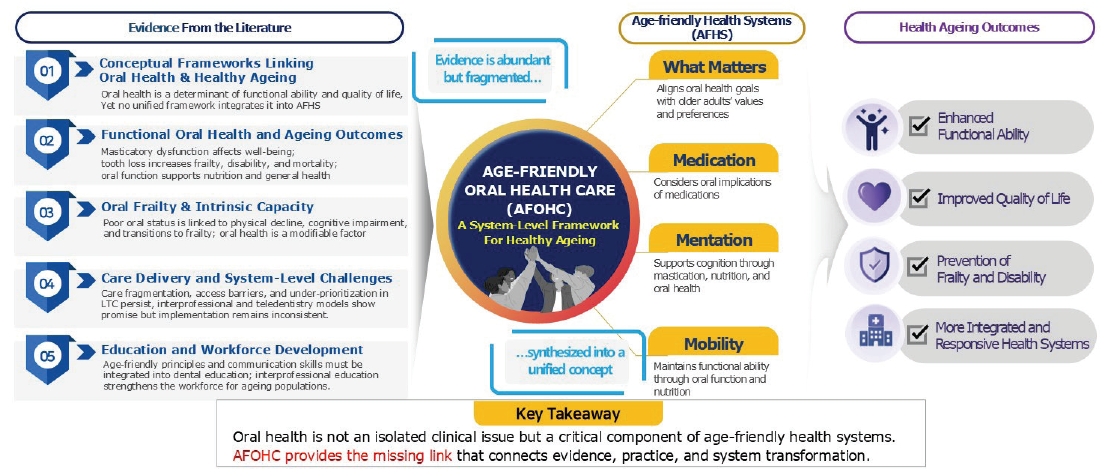
Thematic Synthesis based on the selection of articles. Five thematic domains identified in the literature highlight both the strength and fragmentation of current evidence. AFOHC is proposed as a unified framework that integrates oral health into the AFHS 4Ms—What Matters, Medication, Mentation, and Mobility—to achieve healthy ageing outcomes.
A substantial body of evidence focused on clinical-functional correlates such as masticatory efficiency, dentition status, and chewing ability. Masticatory dysfunction was associated with decreased psychological and social well-being [33,44], while tooth loss was identified as a significant risk factor for frailty, disability, and mortality [30,35,45]. In addition, oral function was found to play a critical role in maintaining nutritional homeostasis and overall health status [27,33].
The literature increasingly links oral health to the constructs of intrinsic capacity and frailty. Poor oral status, often conceptualized as oral frailty, was associated with declines in physical function and increased vulnerability [30,31,35]. Furthermore, studies suggested a bidirectional relationship between masticatory function and cognitive decline [25,27]. Oral health was also identified as a modifiable factor influencing transitions from pre-frailty to frailty [30,35].
The analysis revealed persistent systemic barriers in current dental delivery models. Care fragmentation between dental and general healthcare systems remains a major issue [20,36], while access barriers related to mobility, cognitive impairment, and socioeconomic dependency were consistently reported [41,57]. Oral care is frequently underprioritized in long-term care and community settings [24,31]. Although interprofessional and alternative delivery models such as teledentistry have been proposed, their implementation remains inconsistent [40,41].
The need for an age-friendly dental workforce emerged as a recurring theme. Studies emphasized the importance of integrating age-friendly principles into dental education [21,22], improving communication competencies for cognitively impaired patients [21], and strengthening interprofessional education models to support oral health in aging populations [40].
The synthesis of these domains highlights a critical disconnect. While substantial evidence links oral health to functional aging and frailty, this knowledge remains fragmented across disciplines [18,27,30,35]. Importantly, no study has established a unified framework integrating oral health into AFHS [23,38,39]. This gap suggests that dentistry has yet to fully align with the broader transformation toward age-friendly care, underscoring the need for a system-level conceptual model aligned with the 4Ms framework.
Discussion
This scoping review reveals a paradoxical landscape in geriatric oral health: while the evidence linking oral health to functional aging, frailty, and QoL is robust, its application remains fragmented and isolated. Current research continues to operate within disciplinary silos—geriatric dentistry, epidemiology, and health services—failing to translate clinical findings into a unified, system-level framework. Historically, dentistry has maintained a "procedure-oriented" specialty status, largely disconnected from the broader AFHS movement. This disconnect or evidence system gap suggests that the primary challenge in aging societies is not a lack of clinical evidence, but a lack of systemic integration that aligns oral care with the 4Ms of geriatric care.
The necessity for an AFOHC framework is particularly acute in South Korea, a nation navigating a "time-compressed" transition to a super-aged society. Our analysis highlights three critical structural barriers that characterize the "Korean Paradox". One major challenge is the persistent fragmentation between dental care and the broader systems supporting healthy ageing, including medicine, long-term care, community welfare, nutrition, and functional support services. As a result, oral health is often insufficiently incorporated into multidisciplinary care and public ageing policies, despite its close relationship with frailty, cognition, nutrition, and QoL in older adults [70]. This disconnect may leave frail older adults in a "dental vacuum," where oral health needs are overlooked within comprehensive ageing support systems. The national health insurance structure is heavily weighted toward discrete restorative or surgical interventions. This model provides limited support for the preventive and functional components of AFOHC, such as functional maintenance, caregiver education, and interdisciplinary care coordination, making the adoption of age-friendly models economically unsustainable for practitioners. While clinical expertise is world-class, the dental curriculum has yet to fully embed age-friendly principles. In particular, education related to frailty assessment, communication with cognitively impaired patients, and interdisciplinary geriatric care remains limited, leaving the workforce ill-equipped to lead the shifting demographic reality. In this sense, the Korean paradox reflects not only demographic pressure, but also a structural mismatch between a rapidly ageing society and an oral health delivery system that has yet to be fully integrated into comprehensive healthy ageing and welfare strategies [71].
Given these barriers, the explicit adoption and preemption of the term "Age-Friendly Oral Health Care" is a strategic necessity rather than a mere semantic exercise. In Korea, health policies are often driven by administrative or financial agendas rather than clinical philosophy. By preemptively defining AFOHC through a rigorous academic framework, the dental community can establish a "gold standard," preventing the concept from being diluted into a superficial administrative label or a mere cost-cutting tool. A clearly defined concept serves as a conceptual anchor for aligning research, education, and policy. It provides the dental profession with the intellectual leadership required to ensure that future systemic reforms remain grounded in functional outcomes and patient-centered goals rather than sector-specific interests [72].
While this study provides a comprehensive conceptual framework for AFOHC, the findings should be interpreted within the context of the study design. The literature search was conducted exclusively in PubMed, which may have limited the comprehensiveness of the evidence base by excluding relevant studies indexed in other databases. In addition, the review emphasized conceptual and thematic synthesis rather than quantitative meta-analysis, thereby focusing on framework development rather than statistical evaluation of pooled outcomes. Future research should involve multi-database validation and empirical testing of the proposed AFOHC model in diverse clinical settings.
This scoping review identified five major thematic domains linking oral health and healthy ageing: 1) conceptual frameworks and healthy ageing, 2) functional oral health, 3) oral frailty and intrinsic capacity, 4) care delivery and system integration, and 5) education and workforce development. The findings demonstrate that while substantial evidence supports the association between oral health and ageing-related outcomes, the current evidence remains fragmented and lacks an integrated system-level framework. Based on this synthesis, this study proposes the concept of AFOHC as a person-centered and system-oriented framework that integrates oral health into the broader principles of AFHS. In particular, this study contributes to the field by conceptually distinguishing functional oral health from oral frailty and intrinsic capacity, and by mapping oral health domains onto the 4Ms framework of age-friendly care. Through this approach, AFOHC is positioned not simply as a clinical dental model, but as an essential component of comprehensive healthy ageing and welfare systems for older adults.
Notes
Conflicts of Interest
None
Acknowledgement
The authors acknowledge the use of Generative AI for linguistic refinements and grammatical improvements. All generated suggestions and conclusions were critically reviewed and verified by the authors, who remain responsible for the integrity of the work