Tas2r108 mediates ligand-specific bitter sensitivity and modulates longevity and metabolic health in mice
Article information

Abstract
Purpose
This study aims to elucidate the physiological functions of the type 2 taste receptor 108 (Tas2r108), highly expressed in the tongue and exocrine tissues, focusing on its role in bitter taste perception, metabolic homeostasis, and longevity.
Materials and Methods
To identify specific ligands, calcium imaging was performed using CHO-K1 cells transfected with Tas2r108 and Gα16gust44. For in vivo functional analysis, a Tas2r108 knock-out (Tas2r108-/-) mouse model was generated using CRISPR/Cas9. Sensory sensitivity was evaluated through two-bottle preference tests, and long-term physiological monitoring assessed body weight, blood pressure, glucose levels, and plasma leptin concentrations.
Results
In vitro assays identified cycloheximide as a primary and potent ligand for Tas2r108 compared to denatonium. In behavioral tests, Tas2r108-/- mice showed a significant reduction in bitter sensitivity to cycloheximide, demonstrating this receptor's essential role in detecting specific bitter ligands. Long-term monitoring revealed that Tas2r108 deficiency significantly extends the average lifespan of mice. While no differences were observed in blood pressure, glucose, or total food intake, Tas2r108-/- mice exhibited greater weight gain during adulthood. Notably, plasma leptin levels were higher in the Tas2r108-/- group, correlating with this period of significant weight gain.
Conclusion
These findings demonstrate that Tas2r108 plays a dual role in mediating ligand-specific bitter taste detection and regulating metabolic health and longevity. The results suggest that Tas2r108 may modulate systemic homeostasis through the leptin signaling pathway, identifying it as a potential target for research into aging and metabolic regulation.
Introduction
Taste perception is a critical biological process that guides nutrient intake and reflects the physiological status of an organism. Proper energy and nutrient intake are essential for survival and metabolism. Among the five basic tastes, bitter taste, mediated by type 2 taste receptors (T2Rs), serves as a vital defense mechanism to avoid toxic and harmful substances [1-4]. While T2Rs were initially studied for their role in the tongue, molecular studies have revealed that these receptors are also expressed in various extra-oral tissues, suggesting they play broader physiological roles beyond simple taste detection [5-9].
In the bitter signaling pathway, T2Rs activate alpha-gustducin, leading to a cascade involving PLCβ2 and TRPM5 [10]. This results in Ca2+ release and Na+ influx, which depolarizes the cell and triggers ATP secretion via pannexin and CALHM1/3 to transmit signals to the nervous system [11,12]. Despite having 35 T2Rs in mice, the specific functions of individual receptors in systemic homeostasis remain largely unclarified. Among these, Tas2r108 is particularly noteworthy due to its exceptionally high expression levels. Previous studies have shown that Tas2r108 is expressed 2-6 times higher than GAPDH in taste papillae [13] and over 10,000 times higher in exocrine glands, such as the submandibular and lacrimal glands, compared to other T2Rs [8,14]. This unique expression pattern in exocrine tissues suggests that Tas2r108 may function as a systemic sensor that influences metabolic health and survival.
Furthermore, metabolic homeostasis is closely linked to hormonal regulation. Leptin, a hormone proportional to body fat, acts on the hypothalamus to suppress appetite and increase energy expenditure [15]. Given the high expression of Tas2r108 in metabolic-related exocrine organs like the pancreas and submandibular gland, it is hypothesized that this receptor may interact with systemic metabolic pathways, potentially affecting lifespan and chronic disease progression.
Therefore, the aims of this study were twofold: first, to identify the specific ligands of Tas2r108 through intracellular Ca2+ activity measurements; and second, to determine its exact physiological role in vivo. Using Tas2r108-/- mice generated via CRISPR/Cas9 technology [16,17], we performed two-bottle preference tests to evaluate taste sensitivity and tracked long-term physiological indicators, including lifespan, body weight (BW), blood pressure, glucose levels, and plasma leptin. This comprehensive approach aims to elucidate the essential role of Tas2r108 in both bitter taste detection and the maintenance of metabolic homeostasis.
Materials and methods
In vitro Ca2+ Imaging
CHO-K1 cells (KCLB No. 10061) were cultured in DMEM supplemented with 10% FBS and 1% penicillin-streptomycin at 37 ℃ in 5% CO2. For Tas2r108 expression, a chimeric construct was produced by inserting somatostatin receptor 3 and KOZAK sequences at the 5-prime end of the Tas2r108 gene to enhance membrane localization. The gene fragment was cloned into the pcDNA3.1 expression vector using EcoRI and XhoI restriction enzymes (Fig. 1). The structural components and specific primer sequences used for this cloning process, including restriction sites for NheI, EcoRI, and XhoI, are summarized in Table 1. Cells were co-transfected with Tas2r108 and Gα16gust44 (provided by Yonsei University) using X-treme GENE HP reagent (Roche, Switzerland) at a 1:2 ratio in Opti-MEM. Expression was confirmed by RT-PCR prior to imaging. Cells seeded on cover glasses were loaded with 2mM fura2-AM and pluronic F-127 (Molecular Probes, Inc., Eugene, USA) in Ca2+ measurement buffer (pH 7.4) for 30 minutes at room temperature. After washing, cells were stabilized in the dark for 30 minutes. Fluorescence was measured using a CCD camera-based imaging system (Roper Scientific, USA) and MetaFluor 6.1 software. Intracellular Ca2+ changes (F340/F380) were recorded during perfusion of CHX (5, 50, 500 uM) and DEN (50, 150, 500 uM) at 2 ml/min. Cell viability was confirmed by 1 mM ATP treatment at the end of each session. All reagents were purchased from Sigma-Aldrich (St. Louis, MO, USA) except specifically marked.

Molecular cloning and heterologous expression of Tas2r108. Schematic shows the Tas2r108-inserted pcDNA3.1 expression vector. The Tas2r108 gene (896 bp) is cloned into the mammalian expression vector pcDNA3.1 (5.5 kb).

Primer sequences and structural components for Tas2r108 cloning
Animals and generation of Tas2r108 knock-out mice
All experimental procedures were approved by the Kangwon National University Animal Care and Use Committee and the Living Modified Organism Commission (GWNU-2020-24-1). C57BL/6 mice were purchased from Orient Bio Inc. (Seongnam, Korea). Mice were maintained in standard plastic cages at 23 ℃ with a 12:12 hour light/dark cycle at the Kangwon National University Animal Care Facility.
Tas2r108-/- mice were generated using the CRISPR/Cas9 system (Macrogen Inc., Seoul, Korea). Single guide RNAs (sgRNAs) targeting exons 1 and 2 were validated in vitro using Cas9 protein (Fig. 2A). Validated sgRNA-Cas9 complexes were microinjected into fertilized embryos obtained from pregnant mare serum gonadotropin (Daesung Microbiological Labs, Inc., Uiwang, Korea) and human chorionic gonadotropin (Daesung Microbiological Labs, Inc.)-treated female mice. F0 mosaic mice were crossed with Tas2r108+/+ mice to produce F1 heterozygotes (Fig. 2B). F2 homozygotes were obtained through intercrossing F1 mice (Fig. 2B. Genotypes were confirmed by PCR of tail DNA and sequencing. The specific primers used for genotyping were as follows: forward primer (5`- TGC TCT TGG AGG AAC AGA TTC-3`) and reverse primer (5`- GTG GCC TTC ATT CAT GGA CT-3`). The PCR products were analyzed to distinguish between wild-type (1,448 bp) and knock-out (602 bp) alleles based on their respective molecular weights (Fig. 2C).
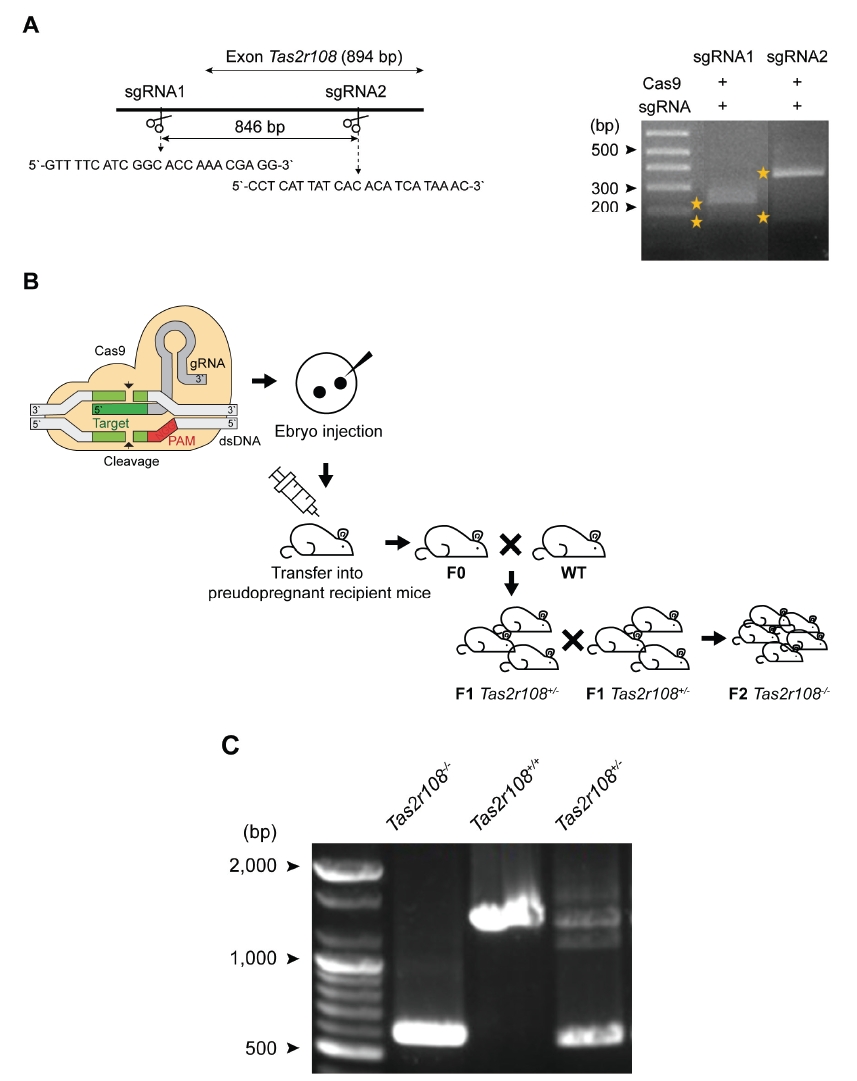
Generation of Tas2r108 knock-out mice using the CRISPR/Cas9 system. (A) Schematic represents the target site of Tas2r108 sgRNA and its evaluation of cleavage efficiency. Electrophoresis validates the effectiveness of the sgRNA targeting the exon of the Tas2r108 gene. (B) Schematic illustration shows the generation of Tas2r108 knock-out (Tas2r108-/-) mice. (C) PCR-based genotyping identifies F2 generation mice. The representative electrophoresis image displays PCR products from F2 mice. Tas2r108 mosaic (+/−) F0 and wild-type (+/+) mice were crossed to obtain F1. Tas2r108+/− F1 hybrids are intercrossed to generate Tas2r108−/−, Tas2r108+/−, and Tas2r108+/+ F2 mice.
Behavioral and physiological assessments
Male Tas2r108+/+ and Tas2r108-/- mice were individually housed and tested for 48 hours. Mice were provided with two 10 ml pipettes containing water and a bitter solution (CHX or DEN). Pipette positions were swapped every 24 hours to avoid side preference. Fluid intake was measured every 24 hours. The preference score was calculated as: (Bitter solution intake / Total intake) x 100.
To evaluate the long-term effects of Tas2r108 deficiency, mice were monitored until natural death. BW, blood pressure, and blood glucose were measured every two weeks. Blood pressure was recorded from the tail artery using a non-invasive system, CODA-HT2 (Kent Scientific, Torrington, CT, USA), and glucose was measured from peripheral blood using a glucometer, Accu-Chek (Roche Diagnostics, Rotkreuz, Switzerland).
Plasma leptin levels were measured at 8, 12, 16, 20, and 24 weeks of age. Blood was collected from the jugular vein into heparin-treated tubes and centrifuged at 12,000 rpm for 25 minutes. Separated plasma was stored at -80 ℃. Leptin concentration was determined using a mouse/rat leptin ELISA kit (Cat. No. M1305, Morinaga Institute of Biological Science, Inc., Yokohama, Japan) following the manufacturer's protocol, with absorbance measured at 450 nm.
Statistical analysis
Data were analyzed using the unpaired t test for comparisons between two groups. For concentration-dependent responses, one-way analysis of variance (ANOVA) followed by Tukey’s post-hoc test was performed to determine statistical significance. All results are expressed as mean plus or minus SEM, and p < 0.05 was considered statistically significant.
Results
Identification of Tas2r108 ligands via cell transfection and Ca2+ imaging
To verify the molecular function of the receptor, we performed in vitro signaling analysis using CHO-K1 cells. RT-PCR confirmed the expression of Tas2r108 (896 bp) and Gα16gust44 (1,125 bp) in the transfected cells (Fig. 3A). Intracellular Ca2+ imaging revealed that Tas2r108-transfected cells exhibited robust Ca2+ increases in response to 5 uM and 50 uM CHX (Fig. 3B). In contrast, among the tested concentrations of DEN, only 50 uM elicited a significant response (Fig. 3C). When the Ca2+ activity for 50 uM CHX and DEN was compared relative to the ATP-induced response, the activity for 50 uM CHX was significantly higher than that for 50 uM DEN (p < 0.001) (Fig. 3D). These results identify CHX as a primary and potent ligand for Tas2r108.
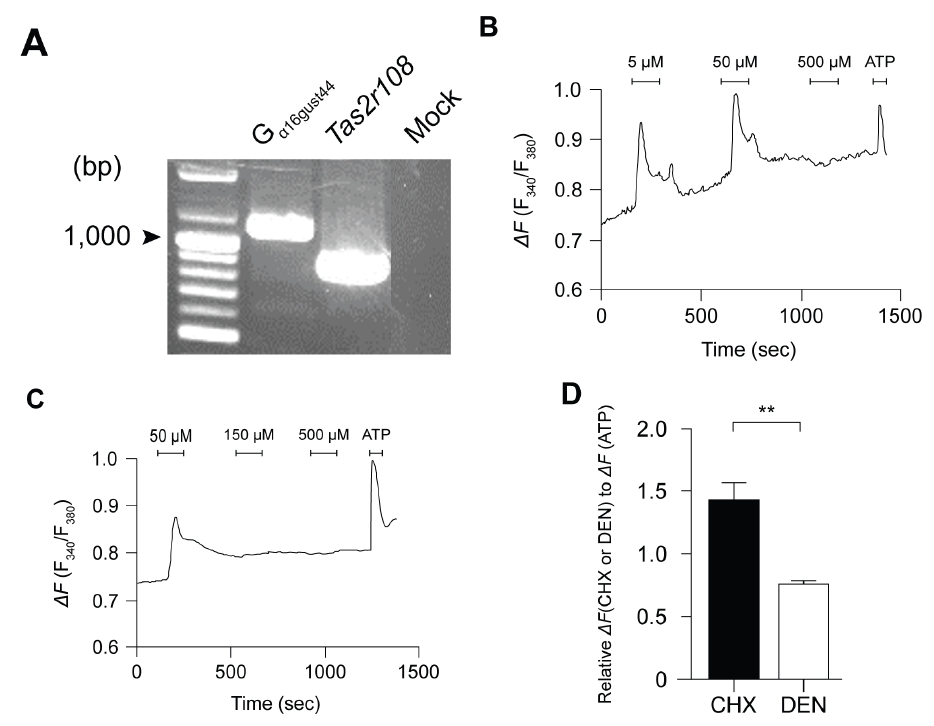
Functional characterization of Tas2r108 in a heterologous cell expression system. (A) RT-PCR analysis shows the expression of Tas2r108 and Gα16gust44 expression in CHO-K1 cells. Lane 1, DNA size marker; Lane 2, Tas2r108 (894 bp); Lane 3, Gα16gust44 (1,125 bp); Lane 4, non-transfected CHO-K1 cells as a negative control (Mock). (B) Representative traces show intracellular Ca2+ activity in response to CHX. Transfected CHO-K1 cells are loaded with fura-2 AM and stimulated with varying concentrations of CHX (5, 50, and 500 μM). (C) Representative traces show intracellular Ca2+ activity in response to DEN. Experimental conditions were identical to (B), with cells stimulated with 50, 150, and 500 μM DEN. (D) Quantitative analysis represents relative intracellular Ca2+ responses. The fluorescence changes are normalized to the response evoked by 1 mM ATP. Data are presented as mean ± SEM (**p < 0.001, unpaired t-test, n=3).
Generation and genotyping ofT as2r108 knock-out mice
To investigate the physiological role of Tas2r108, we generated Tas2r108-/- mice using the CRISPR/Cas9 system. Following the microinjection of the Cas9 protein-sgRNA complex into fertilized embryos, 40 F0 generation mice were obtained. Among them, five mice (two males and three females) were identified as Tas2r108 mosaic founders. These founders were crossed with Tas2r108+/+ mice to produce F1 heterozygotes, and subsequent intercrossing of F1 mice yielded F2 offspring. The F2 generation consisted of 4 Tas2r108+/+, 12 Tas2r108+/-, and 6 Tas2r108-/- mice (Table 2). This distribution followed the expected Mendelian inheritance ratio, confirming the successful establishment of the Tas2r108-/- line.
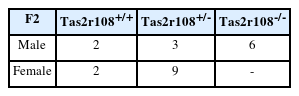
Genotype distribution of F2 generation mice generated by CRISPR/Cas9 system
Reduced Bitter Sensitivity in Tas2r108 knock-out Mice
The effect of Tas2r108 deficiency on bitter taste perception was evaluated using two-bottle preference tests. Notably, a significant reduction in bitter taste sensitivity was observed in Tas2r108-/- mice at a lower concentration of CHX (5 μM), where they exhibited significantly higher preference scores compared to Tas2r108+/+ mice (p < 0.001; Fig. 4A). While both groups exhibited a concentration-dependent avoidance of CHX, the Tas2r108-/- group showed significantly higher preference scores for 50 uM CHX compared to the Tas2r108+/+ group(Fig. 4A). In contrast, no significant differences were observed between 50 μM CHX and DEN within the Tas2r108-/- group (Fig. 4B), suggesting that the loss of Tas2r108 specifically impairs the detection threshold for CHX. These findings demonstrate that Tas2r108 is essential for maintaining high sensitivity to specific bitter ligands like CHX.
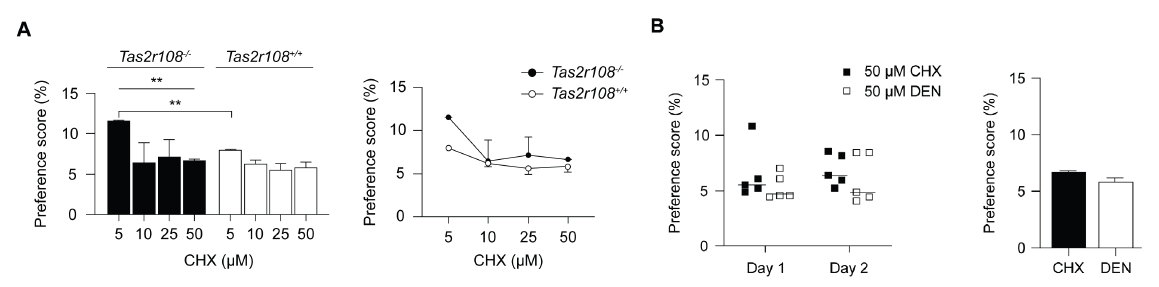
Two-bottle taste preference assays for CHX and DEN in Tas2r108-/- mice. (A) Average preference scores represent 5, 10, 25, and 50 μM CHX in Tas2r108-/- and Tas2r108+/+ mice. Data are presented as mean ± SEM (**p < 0.001, unpaired t-test; *p < 0.01, ANOVA). (B) Daily and average preference scores show behavior toward 50 μM CHX and DEN in Tas2r108-/- mice. Bars represent median (left) and mean ± SEM (right).
Long-term monitoring of BW and lifespan extension
Long-term physiological monitoring until natural death revealed that Tas2r108 deficiency significantly extends the lifespan of mice. The average lifespan of Tas2r108+/+ mice was 472 ± 20 days (67.4 weeks), whereas Tas2r108-/- mice survived for an average of approximately 81.0 weeks(Fig. 5A and B). This represents a statistically significant lifespan extension of about 14 weeks compared to the Tas2r108+/+ group (Fig. 5B). Regarding BW, Tas2r108-/- mice exhibited greater weight gain between 16 and 60 weeks of age (Figs. 5A and C). Notably, both groups showed a characteristic rapid weight loss during the terminal phase of life. No adverse effects on embryonic development or reproductive capacity were observed in the Tas2r108-/- mice (data not shown).
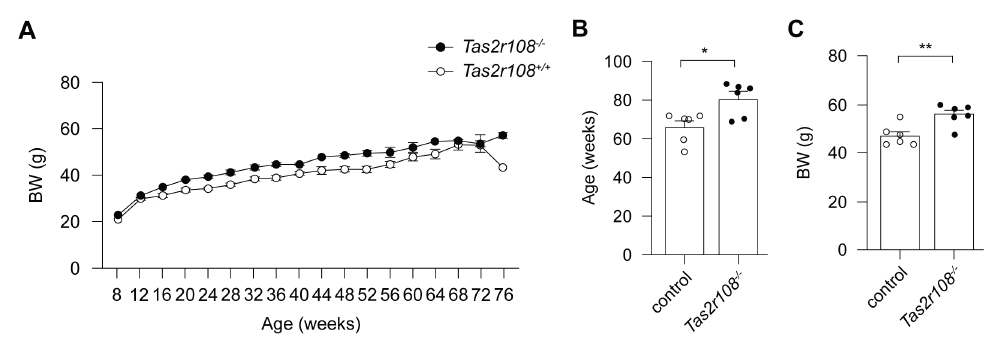
Analysis of body weight (BW) and and lifespan in Tas2r108-/- mice. A. Longitudinal changes represent BW from 8 to 76 weeks of age in Tas2r108-/- and control mice. Data are presented as mean ± SEM (unpaired t-test). B. Comparison shows BW between Tas2r108-/- and control mice at 60 weeks of age. Data are presented as mean ± SEM (*p < 0.01, unpaired t-test). C. Survival analysis represents the recording of longevity in Tas2r108-/- and control mice. Data are presented as mean ± SEM (**p < 0.001, unpaired t-test).
Changes in plasma leptin levels during the lifespan
To assess the metabolic changes associated with the observed BW differences, we measured plasma leptin levels at 8, 12, 16, 20, and 24 weeks. Plasma leptin levels in Tas2r108-/- mice were significantly higher than those in Tas2r108+/+ mice at the 12, 16, and 20-week marks (Fig. 6). This increase in leptin levels correlated with the period of significant weight gain observed in the Tas2r108-/- group. In contrast, no significant differences were found in blood pressure, blood glucose, or total food intake between the two groups (data not shown), suggesting that Tas2r108 may specifically modulate systemic metabolic homeostasis and longevity through the leptin signaling pathway.
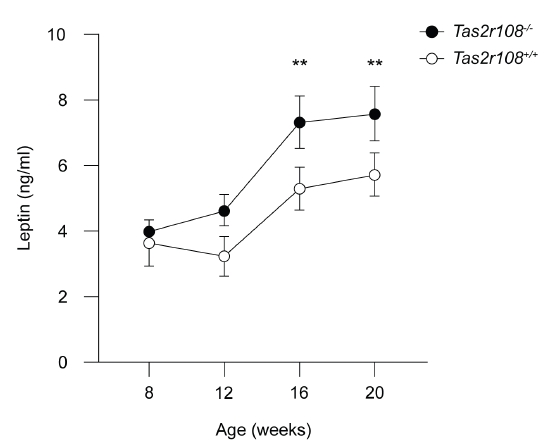
Longitudinal analysis of plasma leptin levels in Tas2r108-/- and wild-type mice from 8 to 20 weeks of age. Changes in plasma leptin concentration are monitored in Tas2r108-/- and wildtype mice. Data are presented as mean ± SEM (**p < 0.001, unpaired t-test, n=3).
Discussion
In conclusion, our study provides a comprehensive functional characterization of Tas2r108, identifying it as a high-affinity receptor for CHX and DEN that serves as a critical systemic metabolic regulator. While Tas2r105 was previously identified as a CHX receptor [18], our in vitro data demonstrate that Tas2r108 exhibits a significantly lower activation threshold, responding to concentrations as low as 5 μM. The significantly higher potency for CHX compared to DEN (p < 0.001) and the observed response to 50 μM DEN—a concentration far lower than the millimolar ranges reported in HEK-293T systems [19,20]—suggest that Tas2r108 functions as a specialized, high-sensitivity sensor. Interestingly, the lack of response at 500 μM CHX suggests a "bell-shaped" dose-response curve or a tight homeostatic signaling window, indicating that Tas2r108-mediated signaling may be subject to strict desensitization or regulatory feedback to prevent overactivation [21].
The in vivo physiological relevance of this high sensitivity was confirmed by the Tas2r108-/- mouse model. The most profound behavioral divergence between wild-type and KO mice occurred at the lowest tested concentration (5 μM CHX), where Tas2r108-/- mice failed to show typical avoidance behavior (p < 0.001). This identifies Tas2r108 as the primary mediator for low-intensity bitter signals, whereas the maintenance of avoidance at higher concentrations suggests that other T2Rs provide redundant protection against toxic bitterants at high doses. Given its overwhelming expression in exocrine glands and its evolutionary conservation [22], Tas2r108 likely exerts a systemic regulatory influence, possibly acting as a metabolic gatekeeper that modulates the expression of other type 2 taste receptors within the chromosome 6 cluster [23].
The most striking discovery of this study is the uncoupling of adiposity and mortality in Tas2r108-/- mice. Despite a 10.4% increase in body weight starting after maturity (16 weeks), these mice lived approximately 14 weeks (20%) longer than their wild-type counterparts. This phenomenon strongly supports the ‘Obesity Paradox’, wherein moderate weight gain in later life serves as a protective energy reservoir against aging-related frailty [24,25].
Crucially, our temporal analysis revealed that plasma leptin levels began to rise at 12 weeks, preceding the significant divergence in body weight. This temporal sequence suggests that Tas2r108 deficiency does not simply cause obesity; rather, it directly alters the metabolic set-point or leptin secretion pathways. The elevation of leptin without a corresponding reduction in food intake indicates a state of adaptive leptin resistance or a fundamental shift in how the hypothalamus integrates metabolic signals [14,25]. The fact that this healthy obesity occurred without changes in blood pressure or glucose levels suggests that Tas2r108-/- mice maintain metabolic health despite increased adiposity. Collectively, these findings identify Tas2r108 as a novel target for aging research, demonstrating that its modulation can decouple the negative effects of weight gain from the benefits of extended longevity.
Notes
Conflicts of Interest
None