지역사회 통합돌봄 시대의 노인치의학 교육과정 개발: 방문치과진료와 방문구강관리를 위한 ADDIE 기반 설계 제안

Geriatric dentistry curriculum development for community-based integrated care in Korea: An ADDIE-based proposal for domiciliary dental treatment and home-based oral care

Article information

J Korean Dent Assoc. 2026;64(10):346-358
Publication date (electronic) : 2026 October 31
doi : https://doi.org/10.22974/jkda.2026.64.10.001
Department of Dental Education, College of Dentistry, Yonsei University, Seoul, Korea
*Corresponding author: Prof. Jeong-Hyun Kang Department of Dental Education, College of Dentistry, Yonsei University, 50-1 Yonsei-ro, Seodaemun-gu, Seoul 03722, Korea Tel: +82-2-2228-2973, E-mail: irene85@yuhs.ac

This study was supported by the Yonsei University College of Dentistry Fund(6-2026-0044).

Received 2026 July 15; Revised 2026 October 16; Accepted 2026 October 19.

Trans Abstract

The implementation of the Integrated Community Care Act in Korea provides a legal and institutional basis for domiciliary dental care and home-based oral care. However, current undergraduate and continuing dental education remain focused on disease-oriented diagnosis and treatment in clinic-based settings. This narrative review proposes directions for dental curriculum development, focusing on frail, care-dependent older adults who require oral care in home and facility settings. This article is a narrative review, which suggests policy-informed curriculum design proposal, and proposes a dental curriculum for integrated community care using the Analysis, Design, Development, Implementation, and Evaluation (ADDIE) model as an organizing framework. Based on the legal and policy context and literature on oral frailty, oral hypofunction, domiciliary dental care, interprofessional collaboration, and caregiver education, six educational competency areas were organized: institutional literacy and community resource linkage; function-oriented oral assessment and care planning; clinical decision-making and risk management in domiciliary settings; interprofessional communication and care coordination; education of family and caregivers; and recontextualization of conventional dental knowledge for frail, care-dependent older adults. Two delivery formats are proposed: a 15-hour, one-credit elective for undergraduate dental students and an eight-hour blended workshop for graduate students and residents. The evaluation protocol separates changes in perception and self-efficacy from knowledge and observed performance and includes an optional follow-up assessment of workplace application. The proposed curriculum provides a structured starting point for dental education reform, but its feasibility, assessment instruments, and educational effects require expert validation and pilot implementation.

서론

우리나라는 세계적으로 유례를 찾기 어려울 정도로 빠른 속도로 고령화가 진행되고 있다. 2000년 11월 65세 이상 인구 비율이 7%를 넘어서며 고령화 사회에 진입한 이후, 17년 만인 2017년 8월에는 고령 인구 비율이 14.02%에 도달하며 고령 사회에 진입하였고, 이후 7년 4개월 후 2024년 12월, 초고령 사회를 맞이하였다[1]. 이러한 추세는 향후에도 지속되어 2035년에는 노인인구 비율이 전체 인구의 30%를 넘어서고, 2050년에는 40%에 이를 것으로 전망된다. 반면 이를 지탱해야 할 생산가능인구는 2023년 3,657만 명에서 2044년 2,717만 명으로 1,000만 명 가까이 감소할 것으로 예측되어, 부양 부담과 의료·돌봄 인력 공급 사이의 구조적 불균형이 심화될 것으로 예상된다[2].

특히 주목해야 할 지점은, 2040년경 1955~1963년생 1차 베이비부머 세대 약 910만여 명이 75세 이상 후기 고령자로 진입하면서 스스로 독립적인 생활의 영위가 어려워져 장기요양 수급 인구가 급격히 증가할 것으로 전망된다는 점이다[2]. 이러한 변화에 대응하기 위해 정부는 “의료·요양 등 지역 돌봄의 통합지원에 관한 법률” (통합돌봄법)을 제정하였으며, 2026년 3월 27일부터 본격 시행되었다. 통합돌봄법은 ‘Aging in Place (AIP)’의 개념을 기반으로 하며 기존의 시설 중심·공급자 중심 돌봄 패러다임에서 지역 중심·이용자 중심의 통합적 돌봄체계로의 전환을 지향한다[3,4].

거동이 불편하거나 시설·재가 환경에서 돌봄을 받아야 하는 의존적 노인 인구의 비중이 증가한다는 것은, 노인의 구강건강관리와 치과 치료가 더 이상 의료기관 내원이 가능한 독립적 환자만을 전제로 논의될 수 없으며, 거주 현장을 중심으로 한 방문치과진료 및 방문구강관리에 대한 사회적 요구가 빠르게 커지고 있음을 의미한다. 통합돌봄법의 시행으로 방문치과진료와 방문구강관리에 대한 법적·제도적 기반은 마련되었으나, 이를 실제로 수행할 치과의사의 역량은 별개의 문제로 남아 있다. 최근 의과 영역에서도 재택의료 확대 정책이 추진되고 있음에도 일선 의사의 참여가 저조한 현상이 지속되고 있으며, 그 원인의 하나로 학생 교육과정에서 재택의료 관련 내용이 충분히 다루어지지 못하고 있다는 점이 거론되고 있다. 이는 제도가 마련되어도 이를 현장에서 수행할 인력이 그에 상응하는 교육을 받지 못한다면 정책의 실효성이 제한될 수 있음을 시사하며, 치과계 역시 동일한 구조적 문제에 직면할 가능성이 높다.

그러나 현재 국내 치과대학·치의학전문대학원의 노인치의학 교과목은 주로 노인성 구강 질환의 진단과 치료라는 전통적 임상 지식에 초점이 맞추어져 있으며, 방문진료 환경에서 요구되는 노쇠와 구강노쇠, 의존적 노인에 대한 이해, 건강보험·장기요양 체계, 실제 방문진료의 운영 방식, 다직역 협업, 그리고 이를 체득하기 위한 현장실습 경험 등은 충분히 다루어지지 않고 있다. 졸업 후 임상 현장에 진입한 치과의사들 또한 이러한 역량을 보수교육 등을 통해 보완할 기회가 제한적인 상황이다.

따라서 통합돌봄법 시행이라는 제도적 전환기를 맞아, 치과의사에게 새롭게 요구되는 역량을 구체적으로 정리하고, 이를 학부와 전문대학원 노인치의학 교육과정을 개편하고 전공의, 대학원생을 포함하는 졸업 치과의사 대상 교육에 반영하기 위한 체계적인 논의가 필요한 시점이다. 본 종설은 이러한 필요성에 기반하여, 분석, 설계, 개발, 실행, 평가 (analysis, design, development, implementation, and evaluation, ADDIE) 교육과정 개발 모형을 중심으로 통합돌봄법 시대에 부합하는 교육과정 개발 방향을 제시하고 파일럿 프로그램 안을 제시하고자 한다. 본 종설은 실증 연구 결과를 보고하기 위함이 아니라, 통합돌봄법 시행에 따라 요구되는 치과의사 역량 영역을 문헌과 정책자료에 근거해 정리하고, 이를 교육개발 모형에 입각하여 교육과정 설계안으로 제안하는 정책 기반 서술적 종설이다. 지역사회 통합돌봄 정책은 법적으로 노인에 한정되지 않지만, 정책 형성 과정에서는 AIP라는 노인돌봄 패러다임과 밀접하게 연결되어 발전해 왔으며, 2018년 “지역사회 통합돌봄 기본계획 1단계”는 노인 커뮤니티케어를 중심으로 제시되었다. 이에 본 종설은 통합돌봄법 대상자 전체를 포괄하는 교육과정 표준안을 제시하기보다, 초고령 사회 진입과 노인치의학 교육과정 개편의 시급성을 고려하여 노쇠·의존 노인의 방문치과진료와 방문구강관리에 필요한 치과의사 역량과 교육과정 설계 방향에 초점을 두었다.

본론

자료 및 고찰 범위

본 종설은 통합돌봄법 시행에 따라 치과의사에게 요구될 것으로 예상되는 역량 영역을 문헌 및 정책자료에 근거하여 정리하고, 이를 치과 교육과정 설계안으로 제안하는 서술적 종설이자 정책 기반 교육과정 설계 제안이다. 이를 위해 초고령사회 진입과 통합돌봄법 시행에 관한 인구·정책 자료, 국내 방문진료 및 재택의료 관련 시범사업 자료, 구강노쇠와 구강기능저하, 방문치과진료, 다직종 협업, 돌봄인력 교육 및 치의학교육 관련 선행문헌을 검토하였다. 검토 범위는 노쇠·의존 노인의 방문치과진료와 방문구강관리에 한정하였다. 검토한 자료를 바탕으로 통합돌봄 환경에서 치과의사에게 요구되는 수행과업과 기존 교육과정의 격차를 정리하고, ADDIE 모형의 분석, 설계, 개발, 실행 및 평가 단계에 따라 교육목표, 교육내용, 교육모듈, 운영방식 및 평가전략을 구조화하여 제시하였다.

통합돌봄법 시행에 따라 요구되는 치과의사 역량

통합돌봄법 시행에 따라 치과의사들에게 요구되는 첫 번째 역량은 구강기능 및 관리 중심 체계로의 인식 전환이다. 현행 치과대학·치의학전문대학원의 임상 교육은 보존, 보철, 구강악 안면외과, 치주, 구강내과 등 진료 과목별로 구성되어 있으며, 그 핵심은 해부학적·병태생리학적 개념에 기반하여 구강 내 질환을 정확히 진단하고 이를 치료하는 데 있다. 이러한 질환·치료 중심적 접근은 의존적이지 않고 스스로 병원에 내원할 수 있는, 복합 이환이 나타나지 않는 환자를 대상으로 할 때에는 효과적으로 기능한다. 그러나 통합돌봄법 시행으로 진료의 장이 의료기관에서 환자의 생활 현장(자택, 요양시설, 데이케어센터 등)으로 확장되면서, 치과의사가 마주하는 환자군의 특성 자체가 근본적으로 달라지고 있다. 스스로 독립적 생활을 영위하기 어려운 의존적 노쇠 환자에서는 구강 질환의 치료보다 현재의 구강기능을 유지하고 더 이상의 저하를 막는 것이 임상적으로 더 의미 있는 목표가 된다. 이러한 맥락에서 최근 국내외 노인치의학계가 주목하는 개념이 구강기능저하 (oral hypofunction)와 구강노쇠 (oral frailty)이다. 구강노쇠는 노화에 따른 구강악안면 기능의 저하에 따른 생리적 예비능의 감소로 정의되며, 전신 노쇠 발생과 악화의 중요한 위험 요인으로 간주된다[5]. 이는 단편적 지표에 국한된 개념이 아니라, 저작장애, 연하곤란, 설구순 운동능력 저하, 구강위생상태 불량, 구강건조 등을 포함하는 다차원적 기능 저하 상태를 의미하며, 구강노쇠는 결국 신체 노쇠, 기능저하, 사망 위험 증가로 이어질 수 있다는 점에서 의미를 갖는다[6-8]. 국내에서도 이러한 흐름에 대응하기 위하여 ‘한국형 구강노쇠 진단기준’을 발표하는 등 학술적 논의가 본격화되고 있다. 한국보건의료연구원 (National Evidencebased Healthcare Collaborating Agency)은 대한치의학회와 함께 국내형 구강노쇠 진단기준 및 진료지침 마련을 위한 원탁회의를 개최하였으며, 대한치과의사협회 치과의료정책연구원은 구강노쇠 임상진료지침과 진단 기준을 발표하고 이를 검증하기 위한 작업을 지속하고 있다[9,10].

두 번째 역량은 다직역에 대한 이해와 직역 간 커뮤니케이션과 관련한 역량이다. 방문치과진료 및 방문구강관리의 효율적 정착과 발전을 위해서는 치과대학·치의학전문대학원 단계부터 재택의료, 방문치과진료에 대한 적절한 교육을 제공할 필요가 있다. 방문진료는 의료기관 내 단독 진료와는 본질적으로 다른 협업 구조를 전제로 한다. 방문치과진료 및 방문구강관리의 대상이 되는 환자는 거동이 불편하고 일상생활 영위가 어려운 환자로 장기요양보험 등급판정을 받고 케어플랜에 따라 관리되고 있는 경우가 많으며, 의사, 간호사, 작업치료사, 물리치료사, 요양보호사, 그리고 사회복지사와 정보를 공유하고 역할을 조정해야 하는 상황이 일상적으로 발생한다. 따라서 이러한 다양한 직역의 전문성에 대한 이해와 협업 가능성에 대한 교육이 반드시 시행되어야 하나 현재 교육과정에서는 이를 충분히 반영하지 못하고 있다. 방문치과진료 및 방문구강관리의 대상이 되는 의존적 환자는 치과치료 전 전신질환, 다약제 복용, 최근 건강 변화 등에 대한 파악이 필수적이다. 따라서 이를 파악하고 있는 의사와 간호사와의 정보 공유가 필수적이다. 환자의 상태에 대한 정보의 공유에만 그치지 않고 이를 진료 계획에 반영하고 구강 건강 및 기능과 관련한 내용을 케어플랜에 반영할 수 있도록 전달할 수 있는 협업 역량도 갖출 필요가 있다[11]. 물리치료사는 시설·재가 환경에서 노인의 이동 능력, 신체기능, 근력, 균형 등을 평가하고 훈련하는 전문직역으로, 구강기능과 신체기능은 노쇠라는 공통적인 기전을 통해 밀접하게 연결되어 있기 때문에 물리치료사의 전문 영역에 대한 이해가 필수적이다. 작업치료사의 협업은 특히 연하장애나 인지저하를 동반한 환자에게서 중요하다. 구강근육 운동이 연하장애 완화, 타액분비 증가, 발음 증진에 효과가 있다는 점에서 작업치료사가 평가하는 연하 및 인지 기능 수준이 치과적 처치의 방식과 안전성을 결정하는 데 중요하기 때문에 치과의사는 이러한 평가 정보를 이해하고 진료계획에 반영하는 역량을 갖출 필요가 있다[11]. 다양한 장기요양서비스와 지역사회 연계를 위해서는 사회복지사의 역할도 필수적이며 이러한 이유로 “장기요양 재택의료센터 시범사업”에서는 사회복지사가 필수 참여 인력으로 명시되어 있다. 요양보호사와의 협업은 일상적 구강관리 실천이라는 측면에서 가장 직접적이다. 요양시설 입소 노인의 구강건강관리는 실질적으로 요양보호사의 역할에 크게 의존하지만, 국내 연구에 따르면 요양보호사들은 노인의 정서적·신체적 기능 변화에 대한 지식과 이해가 부족하고 구강관리 과정에서 발생하는 문제에 대처하는 데 어려움을 겪고 있는 것으로 나타났다[12]. 실제로 요양보호사가 입소 노인의 구강관리 수행에 어려움을 겪는 주된 이유는 구강관리 방법에 대한 어려움과 지식 부족으로 보고되었으며, 칫솔질법이나 의치관리 등 구체적인 교육 콘텐츠에 대한 요구가 높게 나타났다. 현장에서 환자의 일상생활을 가장 가까이에서 보조하는 요양보호사는 실질적인 구강위생관리의 수행 주체이므로, 이들에게 적절한 구강관리 방법을 교육하고 소통하는 역량 역시 치과의사에게 요구된다. 이는 치과의사가 단순히 진료를 제공하는 데 그치지 않고, 현장에서 매일 환자를 돌보는 요양보호사에게 실천 가능한 구강관리 방법을 교육하고 지속적으로 소통하는 역량을 갖추어야 함을 보여준다[12].

통합돌봄 환경에서 방문치과진료와 방문구강관리가 실제 서비스로 작동하기 위해서는 치과의사가 건강보험제도, 노인장기요양보험제도, 지역사회 기반 통합돌봄 전달체계의 차이와 연계 구조를 이해하고 현재 진행되고 있는 방문진료 관련 시범 사업을 이해할 필요가 있다. 현재 국내에서 방문진료와 재택의료의 제도적 기반은 주로 “일차의료 방문진료 수가 시범사업”과 “장기요양 재택의료센터 시범사업”을 통해 형성되고 있다. “ 일차의료 방문진료 수가 시범사업”은 거동 불편 등으로 의료기관 내원이 어려운 환자에게 의사가 환자의 거주지를 방문하여 진료를 제공하고, 이에 대한 건강보험 수가를 적용하는 사업이다. 건강보험심사평가원은 2026년 3월 개정 지침에서 방문진료 수가와 관련된 내용을 안내하였고, 공공의료원, 보건소, 보건지소의 방문진료료 산정 기준도 신설하였다. 이는 방문진료가 의원급 의료기관뿐 아니라 지역보건의료기관으로 확대될 수 있는 제도적 기반을 제공한다는 점에서 의미가 있다[13]. “장기요양 재택의료센터 시범사업”은 장기요양보험 수급자를 대상으로 의사, 간호사, 사회복지사 등으로 구성된 다학제 팀이 가정을 방문하여 의료서비스를 제공하고, 필요한 경우 지역의 사회·요양·돌봄 자원을 연계하는 사업이다. “일차의료 방문진료 수가 시범사업”이 환자의 요청이 있을 때만 이루어지는 일회성 왕진 개념이라고 한다면 “장기요양 재택의료센터 시범 사업”은 포괄 케어플랜 하에서 정기적, 연속적 방문을 전제하는 주치의 개념 기반이다. 이 사업은 단순 방문진료보다 대상자의 건강상태, 치료 요구, 주거환경, 돌봄 필요를 함께 평가하고 지역자원과 연결한다는 점에서 통합돌봄 전달체계와 밀접하다[14].

“일차의료 방문진료 수가 시범사업”과 “장기요양 재택의료센터 시범사업”은 직접적인 치과 관련 시범사업은 아니지만, 방문형 의료서비스가 제도 안에서 어떻게 수가화되고, 대상자를 선정하며, 다직종 팀과 지역자원 연계 구조를 만드는지를 보여주는 선행 제도이다. 따라서 방문치과진료·방문구강관리를 교육과정에 반영하려면 이들 사업을 “치과의 직접 모델”이 아니라 “방문형 의료·돌봄 전달체계의 참조 모델”로 이해해야 한다. 따라서 교육과정에서는 두 사업의 기반이 되는 건강보험제도, 노인장기요양보험제도에 대해 다루어야 한다. 한편 “장애인 건강 주치의 시범사업” 및 “장애인 치과주치의 시범사업” 등과 관련 제도는 각각 방문 건강관리와 장애인 구강관리라는 인접한 정책 영역에 해당하지만, 본 종설이 다루는 노쇠·의존 노인의 재가·시설 기반 방문치과진료 및 방문구강관리와는 대상자 특성 및 서비스 제공 방식이 다르므로 본 절에서는 직접적인 교육과정 설계의 범위에 포함하지 않았다.

그러므로 각각 방문치과진료와 방문구강관리가 향후 통합 돌봄 체계 안에 안정적으로 포함되기 위해서는 치과의사가 이들 두 제도의 대상자, 재원, 서비스 제공 방식, 의뢰·연계 경로를 이해하고, 지역사회 내 다른 직역과 협력할 수 있는 역량을 갖추어야 한다.

ADDIE 모형에 기반한 통합돌봄 치과 교육 과정안 개발

통합돌봄 환경에서 치과의사에게 요구되는 역량은 이전의 질병 진단 및 치료에 한정되지 않는다. 재가 또는 시설 거주 노쇠·의존 노인의 구강건강과 구강기능을 평가하고, 제한된 방문 환경에서 안전한 진료 범위를 결정하며, 보건의료·요양·돌봄 인력과 정보를 공유하고 환자를 적절한 서비스에 연계하는 역량이 함께 요구된다. 이에 본 절에서는 앞에서 검토한 건강보험 및 장기요양보험 체계, 구강노쇠 및 구강기능저하, 방문진료, 다직종 협업 및 돌봄인력 교육에 관한 근거를 교육과정 설계에서 일반 모형으로 자리 잡은 ADDIE의 분석 (analysis), 설계 (design), 개발 (development), 실행 (implementation), 평가 (evaluation) 단계에 따라 교육과정 개발로 구체화한다[15].

단, 본 절에서 제안하는 교육과정은 아직 실제 운영 및 효과 검증을 시행하지 못했으며 따라서 분석, 설계, 개발 단계는 문헌과 정책 자료에 근거하여 도출한 교육과정 설계안이며, 실행과 평가 단계는 향후 파일럿 프로그램 운영을 위한 프로토콜을 제안하는 수준이다. ADDIE는 각 단계의 결과를 이전 단계에 환류하는 반복적 개발 모형으로서[15], 사전 설계에 이어 개별 항목을 점검하고 현장 상황이나 교육 요구에 맞게 조절 가능한 교육과정을 제안하는 데 그 적용 목적을 둔다.

분석 (analysis) 단계는 치과의사에게 요구되는 부분과 실제 역량의 격차를 파악하는 단계이다. 그 첫 번째 단계로 우선 교육 환경과 수행 과업의 변화 상황을 파악해야 한다. 통합돌봄법은 노쇠, 장애, 질병 등으로 일상생활 유지에 어려움이 있는 사람이 살던 곳에서 생활할 수 있도록 보건의료, 건강관리, 장기요양 및 일상생활 돌봄을 통합·연계하는 제도적 틀을 마련하였다[4]. 특히, 제15조는 의사, 치과의사 및 한의사가 의료기관 뿐 아니라 대상자의 가정과 사회복지시설에서 제공하는 진료서비스를 보건의료 통합지원의 범위에 포함하였다. 그러나 법률상 서비스 범위에 치과 방문진료가 포함된 것과 구체적인 치과 수가, 인력, 장비, 감염관리 및 기록체계가 완비된 것은 구별되어야 한다. 따라서, 학습자는 제도의 취지뿐 아니라 가능한 서비스, 미비 영역, 의뢰·연계 경로를 모두 이해할 필요가 있다.

대상자의 변화 또한 새로운 교육 요구를 발생시킨다. 통합돌봄의 주요 대상자는 독립적으로 치과에 내원할 수 있는 건강한 환자만이 아니라 노쇠, 복합질환, 다약제 복용, 인지저하, 이동 제한 또는 장기요양 필요를 가진 재가·시설 거주자이다. 이들에게는 단일 구강질환의 완치보다 통증 및 감염 조절, 저작·연하 등 구강기능 유지, 흡인 및 영양 위험 감소, 일상적 구강관리의 지속가능성이 중요한 치료 목표가 된다. 구강기능저하와 구강노쇠가 전신 노쇠, 영양 문제, 기능 저하 및 사망 위험과 연관된다는 기존 연구와 국내 구강노쇠 선별·진단 기준은 이러한 기능 중심 접근을 뒷받침한다[5-10].

진료 장소가 생활공간으로 확장되면 수행과업도 달라진다. 치과의사는 방문 전 환자의 전신질환, 약물, 인지·의사소통, 이동과 체위, 연하·흡인 위험 및 보호자 상태를 파악하고, 현장의 조명, 전원, 공간, 장비, 감염관리와 응급 대응 조건을 확인할 필요가 있다. 또한, 현장에서 수행할 처치와 의료기관으로 의뢰할 처치를 구분하고 사후관리 계획을 수립할 수 있어야 한다. 방문치과진료 교육을 학부 과정 (1학점)으로 운영한 선행 사례는 방문진료의 개념, 와상환자의 구강상태, 방문진료 계획·수행 및 구강관리 술기 실습을 교육내용으로 구성한 바 있다[16].

통합돌봄은 치과의사 단독 진료가 아닌 다직종 협업을 전제로 한다. 의사와 간호사는 전신질환과 약물 및 건강 상태에 관한 정보를 제공하며 작업치료사와 물리치료사는 연하·인지·일상생활 수행능력과 이동·체위에 관한 정보를 제공하며, 사회복지사는 장기요양서비스와 지역자원 연계를 담당한다. 요양보호사는 일상적 구강관리의 실제 수행자이므로, 치과의사는 환자 상태에 맞는 관리방법을 요양보호사가 이해하기 쉬운 방식으로 교육하고 실행 여부를 점검할 수 있어야 한다. 이미 재택노인 구강관리에서 각 직역의 역할 조정의 필요성과 요양보호사의 구강관리 지식·교육 요구가 보고된 바 있다(Table 1) [11,12].
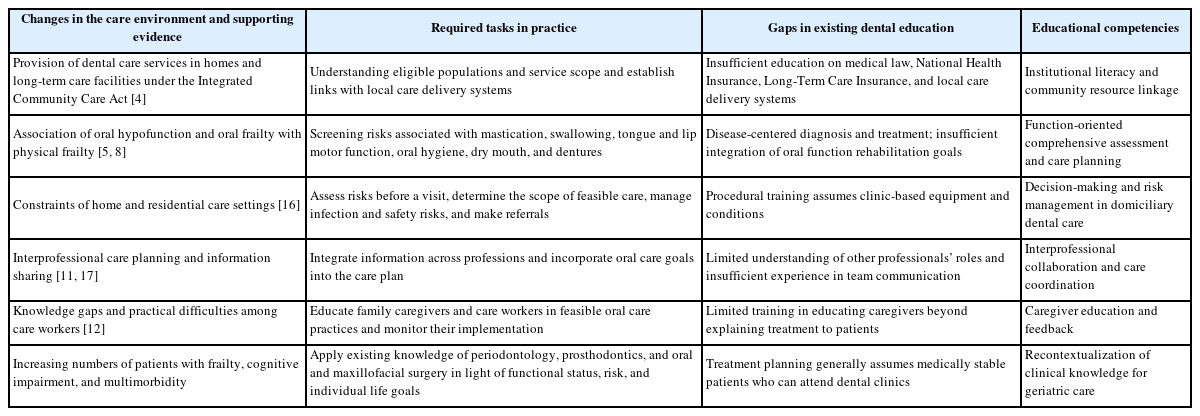
Required tasks and educational competencies in the community-based integrated care environment

두 번째 단계는 학습자가 누구인지 설정하고 현재 교육 환경을 분석하는 단계이다. 본 종설에서는 학습자는 임상 교육을 시작한 치과대학·치의학전문대학원 학생과 졸업 후 치과의사로 구분하여 설정하고 각 학습자별 필요 역량을 기존 법 체계와 교육과정을 바탕으로 별도로 도출하였다. 학부생에게는 실제 방문진료의 독립적 수행을 요구하기보다 통합돌봄의 개념 이해, 구강기능 위험 선별, 방문진료 필요성 판단, 적절한 의뢰 및 협업 인식을 성취수준으로 설정하는 것이 바람직하다. 임상 경험이 있는 졸업 후 치과의사는 환자·환경 위험평가, 방문진료 범위 설정, 기록 및 의뢰·회송, 팀 기반 케어플랜 및 돌봄 인력 교육 등 실제 수행에 가까운 성취수준을 적용할 수 있다.

학부 과정은 제한된 정규 교육시간과 현장실습 장소 확보의 어려움을 고려하여 임상 수행 학년 대상 1학점 선택과목으로 설계할 수 있다. 대학원생, 전공의를 포함하는 치과의사 대상 과정은 근무시간과 임상 경험을 고려하여 온라인 사전학습과 대면 실습을 결합한 8시간 워크숍으로 설계하는 것을 고려해 볼 수 있다. 두 과정 모두 노인치의학 교수자만으로 운영하기보다 치과위생사, 지역 통합돌봄 실무자, 치과 외 보건의료 및 사회복지 직역이 참여하는 교수진을 구성할 필요가 있다.

설계 (design) 단계에서는 교육목표와 교육내용을 구체화한다. 교육과정의 총괄목표는 학습자가 통합돌봄 환경에서 재가·시설 거주 노인의 구강건강과 구강기능 상태와 중재 요구를 파악하고, 전신상태와 생활환경을 고려하여 안전하고 지속 가능한 관리계획을 수립하며, 다직종 팀과 협력하여 필요한 진료와 돌봄서비스에 연계할 수 있도록 하는 것이다. 이를 위한 구체적인 학습성과에는 통합돌봄의 대상과 전달체계 및 치과의사의 역할에 대한 이해, 노쇠·의존 노인의 구강기능과 일상적 구강관리 위험에 대한 선별 능력, 환자와 방문환경의 위험요인을 고려한 방문치과진료의 가능 범위 및 의뢰 필요성에 대한 판단 능력이 포함된다. 아울러 환자의 기능과 전신상태, 가치관 및 돌봄 여건을 반영한 구강기능관리계획 수립, 다직종 구성원과의 정보 공유 및 구강건강 목표의 케어플랜 반영, 보호자와 돌봄인력을 대상으로 한 환자별 구강관리 교육 및 실행 점검 역량을 주요 학습성과로 설정할 수 있다. 이러한 학습성과는 학습자의 임상 경험과 교육단계에 따라 차별화할 필요가 있다. 학부생에게는 통합돌봄 전달체계와 치과의사의 역할에 대한 이해 및 구강노쇠 위험 선별을 기초 성취수준으로 설정하고, 방문진료 적합성 판단, 구강관리계획 수립, 다직종 협업 및 돌봄인력교육은 사례 기반 판단이나 지도하 수행 수준을 목표로 할 수 있다. 반면 졸업 후 치과의사에게는 이러한 학습성과를 시뮬레이션 또는 실제 임상 사례에서 통합적으로 직접 수행할 수 있는 수준을 목표로 설정하는 것이 적절하다(Tables 2 and 3).
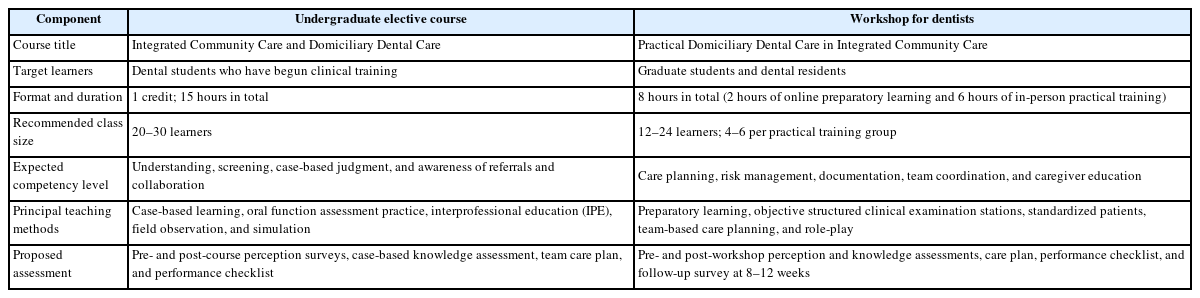
Undergraduate elective course and workshop for dentists
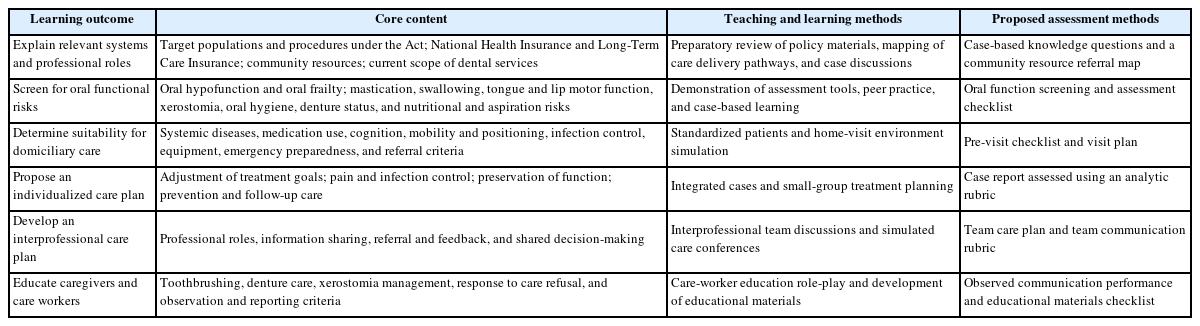
Learning outcomes, teaching and learning methods, and assessment methods

통합돌봄 환경에서 요구되는 치과의사 역량을 교육과정에 반영하기 위해서는 학습성과에 대응하는 교육모듈과 교수학습자료를 체계적으로 구성할 필요가 있다. ADDIE 모형의 개발 (development) 단계에서는 통합돌봄 제도와 치과의사의 역할, 노쇠와 구강기능 평가, 방문 전 환자 및 환경 위험평가, 방문구강관리와 기능 중재, 다직종 협업과 돌봄 조정, 통합 사례 기반 의사결정 및 기록 등을 주요 교육모듈로 구성할 수 있다(Table 4). 각 모듈에는 강의자료와 사례뿐 아니라 구강기능 평가 기록지, 방문진료 준비자료, 보호자 교육자료, 의뢰·회송 양식 및 통합 케어플랜 등 실제 방문진료 환경에서 활용할 수 있는 교육자료를 포함하는 것이 바람직하다. 이러한 교육자료는 임상적 정확성, 학습성과와의 관련성, 표현의 명확성 및 교육환경에서의 활용 가능성을 고려하여 구성되어야 한다. 특히 방문치과진료 경험이 있는 치과의사, 치의학교육 전문가, 치과위생사 및 지역사회 통합돌봄 관련 직역의 의견을 반영한다면 교육내용의 적절성과 현장 적용 가능성을 높일 수 있다. 제안된 교육자료는 향후 전문가 검토와 학습자 대상 예비 적용을 통해 보완할 필요가 있으며, 교육평가에 활용되는 도구에 대해서는 별도의 타당도 검토가 요구된다[18].
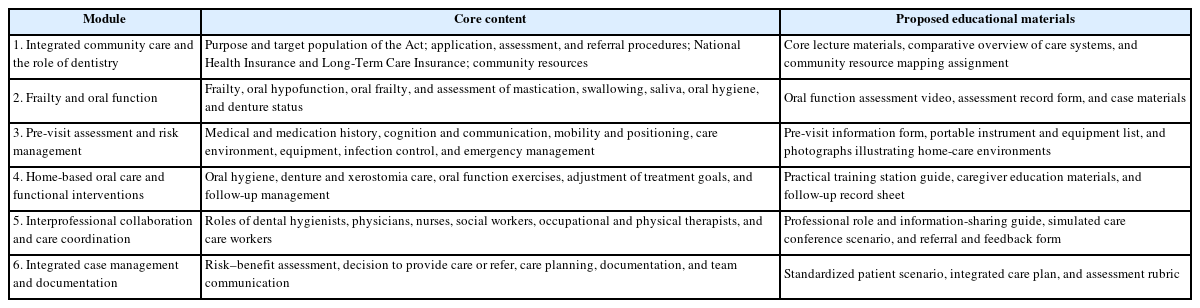
Educational modules and developed materials

방문치과진료 교육에서는 진료실과 다른 환경적 제약을 고려하여 환자안전과 진료 적합성을 체계적으로 판단하는 역량을 강조할 필요가 있다. 이를 위해 환자 확인과 동의, 전신질환 및 약물력, 인지·의사소통 상태, 이동과 체위, 연하·흡인 위험, 구강건강과 기능, 현장 환경과 감염관리, 응급 대응, 의뢰 및 추적관리 등을 포함하는 교육용 체크리스트를 활용할 수 있다(Table 5). 체크리스트는 단순히 방문 전 준비사항을 확인하는 용도에 그치지 않고, 학습자가 확인된 위험요인을 근거로 방문진료의 가능 범위를 결정하고 필요한 의뢰 및 사후관리 계획을 수립하도록 돕는 교육도구로도 활용될 수 있다. 수행평가에 활용하는 경우에는 항목별 수행의 적절성을 구분하여 평가하되, 환자 확인과 동의, 급성 전신위험, 연하·흡인, 감염관리 및 진료 범위 결정과 같이 환자안전에 직접적인 영향을 미치는 항목을 중요하게 다룰 필요가 있다. 다만 제시한 체크리스트와 평가기준은 교육과정 설계를 위한 예시로서, 실제 평가도구로 활용하기 위해서는 임상적 타당성과 평가기준의 적절성에 대한 후속 검토가 필요하다.
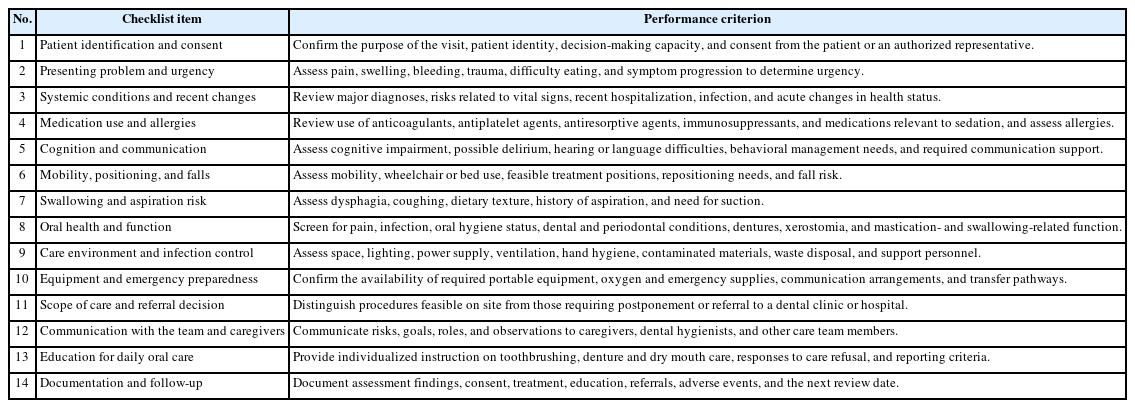
Decision-making checklist for domiciliary dental care

ADDIE 모형의 실행 (implementation) 단계에서는 학습자의 임상 경험과 수행역량에 따라 교육과정을 차별화하여 적용하는 방안을 고려할 수 있다. 학부 교육에서는 통합돌봄법과 방문치과진료 및 방문구강관리의 이해, 구강노쇠 위험 선별 및 다직종 협업에 대한 기초 역량을 강조하고, 졸업 후 치과의사 교육에서는 실제 방문진료 환경에서의 위험평가, 의사결정, 기록 및 돌봄 연계와 같은 실무 역량을 중심으로 교육내용을 구성하는 것이 적절하다.

학부 교육과정은 제한된 정규 교육시간을 고려하여 1학점, 총 15시간의 선택과목 형태로 운영하는 방안을 고려할 수 있다(Table 6). 교육내용은 통합돌봄 제도와 지역사회 전달체계, 노쇠와 구강기능 평가, 방문진료 환경 및 안전관리, 다직종 협업, 통합 사례 기반 학습 등으로 구성할 수 있다. 실제 방문 현장에 대한 관찰이 어려운 경우에는 영상, 공간 도면 및 환자·보호자·직역별 사례자료를 활용한 가상 방문환경을 교육에 적용할 수 있다. 이때 단순한 강의 중심 교육보다는 학습자가 현장의 위험요인을 파악하고 진료 및 의뢰 여부를 판단하며, 다직종 협업을 경험할 수 있는 사례기반학습과 시뮬레이션을 병행하는 것이 바람직하다. 졸업 후 치과의사를 대상으로 하는 교육은 임상 경험과 시간적 제약을 고려하여 온라인 사전학습과 대면 실습을 결합한 8시간 워크숍 형태로 구성할 수 있다(Table 7). 온라인 교육에서는 관련 제도와 방문진료의 기본 원칙을 다루고, 대면 교육에서는 고위험 환자의 방문 적합성 판단, 구강기능 평가, 진료환경 및 감염관리, 다직종 케어플랜 수립, 보호자와 돌봄인력 교육 등 실제 수행 중심의 내용을 강조할 수 있다. 교육의 현장 적용 가능성을 높이기 위해서는 노인치의학 또는 방문진료 경험이 있는 치과의사와 치과위생사뿐 아니라 의사, 간호사, 사회복지사 및 지역사회 통합돌봄 실무자 등 다양한 직역이 교육에 참여하는 것이 바람직하다. 실제 환자나 돌봄 현장을 교육에 활용하는 경우에는 환자 동의, 개인정보보호, 학습자의 수행 범위, 지도·감독 및 감염관리 등 윤리적·안전관리 요소를 충분히 고려해야 한다.

Operational plan for the undergraduate elective course

Plan for the workshop for dentists

교육과정의 효과적인 적용을 위해서는 사전에 계획한 학습성과와 교육내용이 실제 교육과정에서 충실하게 구현되는지를 점검할 필요가 있다. 이를 위해 교육시간과 교수자 구성의 적절성, 학습자의 직접적인 실습 및 의사결정 참여, 다직종 간 상호작용, 평가기준의 일관성, 환자안전과 개인정보보호, 운영과정에서 발생한 변경사항 등을 함께 고려해야 한다. 또한 학습자와 교수자의 피드백을 바탕으로 교육내용과 운영방식을 지속적으로 보완하는 환류체계를 마련하는 것이 바람직하다.

ADDIE 모형의 평가 (evaluation) 단계에서는 학습자의 만족도나 교육 필요성에 대한 인식 변화뿐 아니라 지식, 임상적 판단, 수행 역량 및 향후 현장 적용 가능성을 구분하여 고려할 필요가 있다. 교육 전후의 인식 및 자기효능감 변화는 교육에 대한 학습자의 태도와 자신감 변화를 파악하는 데 유용하지만, 이를 실제 방문치과진료 수행 역량의 향상으로 직접 해석하는 데에는 한계가 있다. 따라서 교육과정 평가에서는 인식·태도와 지식, 사례 기반 의사결정 및 수행평가를 상호 보완적으로 활용하는 접근이 적절하다. 교육 직후에는 학습자의 반응과 지식, 구강기능 선별 및 방문치과진료 및 방문구강관리 계획 수립 능력 등을 평가하고, 일정 기간 이후에는 교육내용의 임상 현장 활용 여부와 다직종 협업 경험 등을 확인하는 방안을 고려할 수 있다(Table 8). 다만 실제 진료행동의 변화나 환자의 구강건강 및 기능 개선, 의료 접근성 향상과 같은 성과는 교육 직후의 평가만으로 확인하기 어려우므로 향후 별도의 연구를 통해 검토할 필요가 있다.
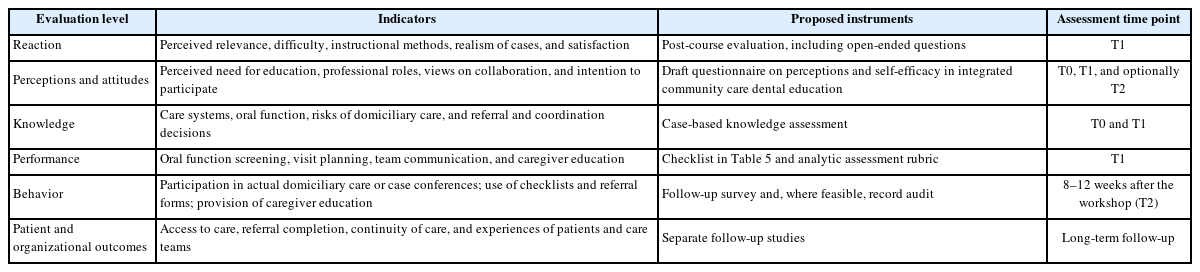
Evaluation levels, indicators, and assessment

교육과정의 인식 및 태도 평가에는 교육 필요성과 전문직 역할에 대한 인식, 통합돌봄 관련 치과업무 자기효능감, 향후 학습 및 실천 의도 등을 포함할 수 있다. 이러한 평가영역은 방문 치과진료 및 방문구강관리 교육과정 운영 연구, 한국어판 전문직 간 태도 척도의 타당화 연구, 장기요양시설 관찰교육 및 방문치과 임상교육의 평가 연구 등을 참고하여 구성할 수 있다[19-21]. 본 종설에서는 이러한 선행문헌과 제안된 교육과정의 학습성과를 바탕으로 세 영역, 총 19개 문항으로 구성된 설문 예시를 제시하였다(Table 9). 다만 각 영역은 서로 다른 구성 개념을 반영하므로 하나의 총점으로 통합하기보다는 영역별로 구분하여 평가하는 것이 적절하다. 제시된 문항은 타당화된 측정 도구가 아니라 향후 교육과정 적용 시 활용을 검토할 수 있는 예시이므로, 실제 활용에 앞서 측정내용의 적절성과 신뢰도 및 타당도에 대한 검토가 필요하다.
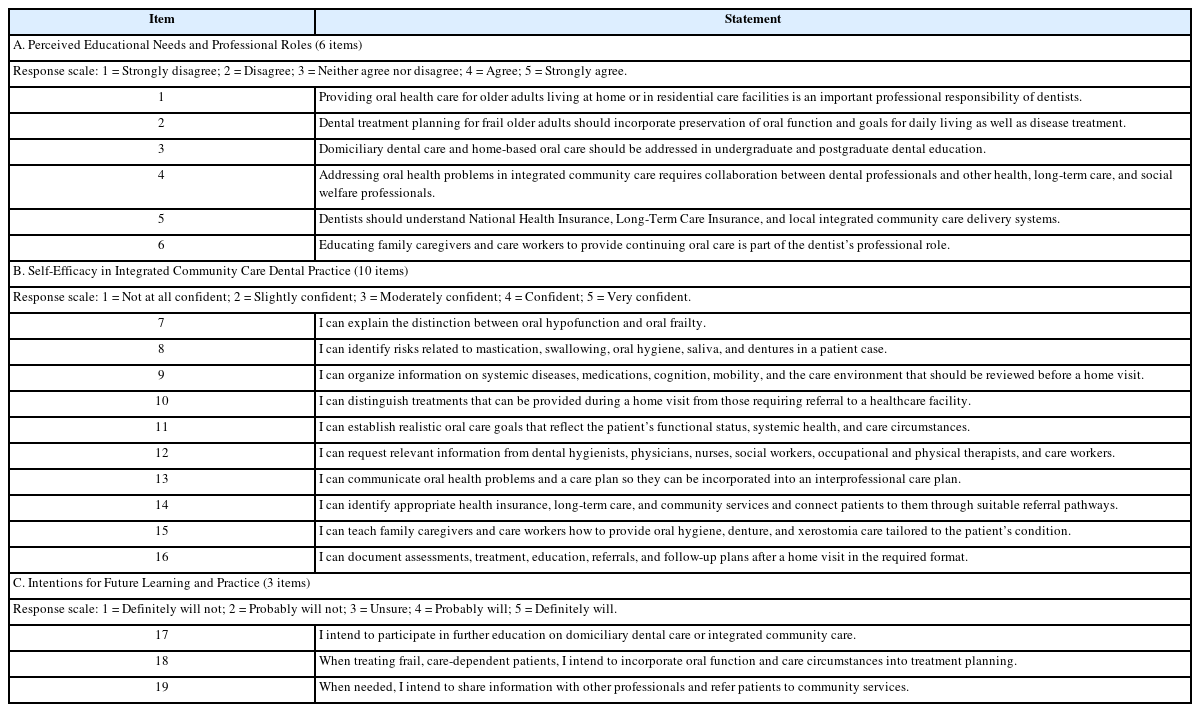
Perception and self-efficacy questionnaire for community-based integrated care dental education

제안된 교육과정의 실제 적용에 앞서 교육목표와 평가영역의 연계성을 검토하고, 학습자 및 관련 전문가의 의견을 반영하여 평가도구를 보완할 필요가 있다. 설문 문항의 경우 기존 도구와의 관련성, 문항의 명확성 및 응답자의 이해 가능성을 검토하는 과정이 요구되며, 수행평가 도구는 임상적 적절성과 평가자 간 일관성을 고려해야 한다[18]. 이후 시범교육을 통해 교육 전후의 지식, 인식 및 수행역량 변화와 학습자의 수용성을 검토한다면 교육과정의 개선 방향을 구체화할 수 있을 것이다. 다만 이러한 평가는 본 종설에서 실제 수행된 것이 아니라 향후 교육과정의 타당성과 효과를 검증하기 위한 후속 연구 방향에 해당한다. 특히 학습자의 자기효능감 향상이 실제 임상 수행이나 환자 수준의 성과로 이어지는지는 별도의 검증이 필요하다.

고찰

본 종설은 통합돌봄법 시행과 초고령사회 진입이라는 정책적·인구학적 전환을 배경으로, 치과의사에게 요구될 것으로 예상되는 역량 영역을 문헌 및 정책자료에 근거하여 정리하고, 이를 반영한 교육과정 설계 방향을 제안하였다. 통합돌봄법의 시행으로 진료의 장이 의료기관에서 환자의 생활 현장으로 확장됨에 따라, 치과의사는 기존의 질환·치료 중심 접근에서 벗어나 구강기능 유지와 저하 방지를 목표로 하는 구강기능 중심 접근으로 전환할 필요가 있으며, 의사, 간호사, 치과위생사, 사회복지사, 작업치료사, 물리치료사, 요양보호사 등 다양한 직역과 협업할 수 있는 의사소통 역량, 그리고 건강보험제도와 노인장기요양보험제도 및 관련 시범사업에 대한 제도적 이해가 함께 요구됨을 법령과 선행 문헌들에 근거하여 구조화하였다.

이에 본 종설은 ADDIE 모형을 분석틀로 활용하여 교육 요구, 학습성과, 교육모듈, 운영방식 및 평가전략을 하나의 설계안으로 제시하였다. 특히 학부생과 졸업 후 치과의사라는 서로 다른 학습자군의 특성을 구분하여, 학부 교육과정에는 통합돌봄과 방문치과진료의 기본 개념 및 구강기능 평가 역량을, 졸업 후 교육에는 실제 방문진료 수행과 제도 활용, 다직종 연계 등 실무 중심 역량을 각각 배치하는 이원화 전략을 제안하였다. 이러한 접근은 이미 임상 경험을 갖춘 치과의사와 아직 임상 경험이 없는 재학생 간의 학습 요구 차이를 고려한 것으로, 한정된 교육 자원 내에서 각 학습자군에게 실질적으로 도움이 되는 교육을 설계하는 데 기여할 수 있을 것으로 기대된다.

다만 통합돌봄법 시행 초기 문헌 및 정책 자료에 대한 분석을 토대로 교육과정 개발 방향을 이론적으로 제시한 설계 연구로서, 실제 교육과정을 운영하고 그 효과성을 검증하는 연구는 아니다. 또한 제시된 교육모듈과 평가 방안은 국내외 선행 연구와 관련 시범사업 현황에 근거하여 구성되었으나, 개별 치과대학·치의학전문대학원의 교육 여건, 교수 인력, 실습 인프라에 따라 실행 가능성에는 차이가 있을 수 있다. 또한 본 설계안은 통합돌봄법 대상자 중 노쇠·의존 노인을 중심으로 구성되었으므로, 노인 외 돌봄 필요군에 요구되는 치과 역량과 교육내용을 충분히 포괄하지는 못한다. 향후 연구에서는 대상자군별 임상적 요구와 전달체계의 차이를 반영한 별도의 교육과정 설계가 필요하다.

향후 제시한 교육과정 개발 방향을 바탕으로 교육 프로그램에 시범 적용하고, 학습자의 지식·술기·태도 변화와 현장 적용 가능성을 평가하는 후속 연구가 필요하다. 아울러 방문치과진료 및 방문구강관리 역량에 대한 표준화된 평가도구 개발, 그리고 다직종 협업 교육의 효과를 검증하는 연구를 통해 통합돌봄법 시대에 부합하는 치과 교육과정이 지속적으로 보완되어야 할 것이다.

Notes

Conflicts of Interest

None

References

1. Ministry of the Interior and Safety. Resident registration population statistics [Internet]. Sejong: Ministry of the Interior and Safety; 2026 [cited 2026 Oct 16]. Available from: https://jumin.mois.go.kr/.
2. Ministry of Data and Statistics. Population projections for Korea: 2022–2072 [Internet]. Daejeon: Ministry of Data and Statistics; 2023 [cited 2026 Oct 16]. Available from: https://mods.go.kr/board.es?mid=a20108080000&bid=11748&act=view&list_no=439555.
3. Lim SM, Kim KH. The implications and challenges of the law on integrated support for regional care, including medical service and care. J Soc Secur Law 2024;54:583–609.
4. Korea Law Information Center. 의료·요양 등 지역 돌봄의 통합 지원에 관한 법률. 법률 제20445호. Sejong: Ministry of Government Legislation; 2024.
5. Dibello V, Zupo R, Sardone R, Lozupone M, Castellana F, Dibello A, et al. Oral frailty and its determinants in older age: a systematic review. Lancet Healthy Longev 2021;2:e507–e520.
6. Minakuchi S, Tsuga K, Ikebe K, Ueda T, Tamura F, Nagao K, et al. Oral hypofunction in the older population: position paper of the Japanese Society of Gerodontology in 2016. Gerodontology 2018;35:317–324.
7. Tanaka T, Hirano H, Ikebe K, Ueda T, Iwasaki M, Minakuchi S, et al. Consensus statement on "oral frailty" from the Japan Geriatrics Society, the Japanese Society of Gerodontology, and the Japanese Association on Sarcopenia and Frailty. Geriatr Gerontol Int 2024;24:1111–1119.
8. Tanaka T, Takahashi K, Hirano H, Kikutani T, Watanabe Y, Ohara Y, et al. Oral frailty as a risk factor for physical frailty and mortality in community-dwelling elderly. J Gerontol A Biol Sci Med Sci 2018;73:1661–1667.
9. Kang JH, Park SC, Jung HI, Jung SJ, Park HJ, Kim SM, et al. Validation of the Korean Academy of Geriatric Dentistry screening questionnaire and oral frailty diagnostic criteria in community-dwelling older adults. Epidemiol Health 2024;46e2024008.
10. So JS, Jung HI, Kim NH, Ko SM, Linton JL, Kim J, et al. Clinical practice guidelines for oral frailty. J Korean Dent Assoc 2022;61:26–58.
11. Shin BR, Jo SR, Jang JH. Exploring perceptions and cost factors home-based oral care interventions for older adults: a focus group study. J Korean Acad Oral Health 2024;48:177–185.
12. Moon SE, Yang JJ, Choi YJ. Care workers' practices in oral healthcare for the elderly: mediating role of elderly oral healthcare education and behavioral needs. J Korean Soc Dent Hyg 2024;24:57–67.
13. 김소희, 박민서, 차선정, 현유림. Second Effectiveness Evaluation of the Primary Care Home-Visit Reimbursement Pilot Program [Internet]. Wonju: Health Insurance Review & Assessment Service; 2025 [cited 2026 Oct 16]. Available from: https://repository.hira.or.kr/handle/2019.oak/3765.
14. 이정석, 권진희, 이희승, 김정희, 김현기, 송희연. 장기요양 재택 의료센터 시범사업 효과 분석: 의료이용과 시설 입소예방 [Internet]. Wonju: National Health Insurance Service, Health Insurance Research Institute; 2024 [cited 2026 Oct 16]. Available from: https://kahm.net/data/1326.
15. Branch RM. Instructional design: the ADDIE approach. New York: Springer; 2009.
16. Yu CH, Chou MY. Implementation of domiciliary dentistry curriculum in dental education: 5-year experience. J Dent Sci 2022;17:1083–1084.
17. Gilbert JH, Yan J, Hoffman SJ. A WHO report: framework for action on interprofessional education and collaborative practice. J Allied Health 2010;39:196–197.
18. Artino AR Jr, La Rochelle JS, Dezee KJ, Gehlbach H. Developing questionnaires for educational research: AMEE Guide No. 87. Med Teach 2014;36:463–474.
19. Park KH, Park KH, Kwon OY, Kang Y. A validity study of the Korean version of the Interprofessional Attitudes Scale. Korean Med Educ Rev 2020;22:122–130.
20. Hillebrecht AL, Dörr L, Schlueter N, Linde P, Reissmann DR, Spies BC, et al. Effects of a one-day shadowing experience on dental students' attitudes toward ageing and geriatric dentistry: a prospective controlled cohort study. BMC Med Educ 2026;26:694.
21. Stillhart A, Solomons M, Leles CR, Spatzier H, Srinivasan M. Effect of clinical rotations in domiciliary dental care on dental students' attitudes, empathy, and perceptions towards institutionalized older adults in Zurich in Switzerland. Spec Care Dentist 2026;46e70192.

Article information Continued

Table 1.

Required tasks and educational competencies in the community-based integrated care environment

Changes in the care environment and supporting evidence Required tasks in practice Gaps in existing dental education Educational competencies
Provision of dental care services in homes and long-term care facilities under the Integrated Community Care Act [4] Understanding eligible populations and service scope and establish links with local care delivery systems Insufficient education on medical law, National Health Insurance, Long-Term Care Insurance, and local care delivery systems Institutional literacy and community resource linkage
Association of oral hypofunction and oral frailty with physical frailty [5, 8] Screening risks associated with mastication, swallowing, tongue and lip motor function, oral hygiene, dry mouth, and dentures Disease-centered diagnosis and treatment; insufficient integration of oral function rehabilitation goals Function-oriented comprehensive assessment and care planning
Constraints of home and residential care settings [16] Assess risks before a visit, determine the scope of feasible care, manage infection and safety risks, and make referrals Procedural training assumes clinic-based equipment and conditions Decision-making and risk management in domiciliary dental care
Interprofessional care planning and information sharing [11, 17] Integrate information across professions and incorporate oral care goals into the care plan Limited understanding of other professionals’ roles and insufficient experience in team communication Interprofessional collaboration and care coordination
Knowledge gaps and practical difficulties among care workers [12] Educate family caregivers and care workers in feasible oral care practices and monitor their implementation Limited training in educating caregivers beyond explaining treatment to patients Caregiver education and feedback
Increasing numbers of patients with frailty, cognitive impairment, and multimorbidity Apply existing knowledge of periodontology, prosthodontics, and oral and maxillofacial surgery in light of functional status, risk, and individual life goals Treatment planning generally assumes medically stable patients who can attend dental clinics Recontextualization of clinical knowledge for geriatric care

Table 2.

Undergraduate elective course and workshop for dentists

Component Undergraduate elective course Workshop for dentists
Course title Integrated Community Care and Domiciliary Dental Care Practical Domiciliary Dental Care in Integrated Community Care
Target learners Dental students who have begun clinical training Graduate students and dental residents
Format and duration 1 credit; 15 hours in total 8 hours in total (2 hours of online preparatory learning and 6 hours of in-person practical training)
Recommended class size 20–30 learners 12–24 learners; 4–6 per practical training group
Expected competency level Understanding, screening, case-based judgment, and awareness of referrals and collaboration Care planning, risk management, documentation, team coordination, and caregiver education
Principal teaching methods Case-based learning, oral function assessment practice, interprofessional education (IPE), field observation, and simulation Preparatory learning, objective structured clinical examination stations, standardized patients, team-based care planning, and role-play
Proposed assessment Pre- and post-course perception surveys, case-based knowledge assessment, team care plan, and performance checklist Pre- and post-workshop perception and knowledge assessments, care plan, performance checklist, and follow-up survey at 8–12 weeks

Table 3.

Learning outcomes, teaching and learning methods, and assessment methods

Learning outcome Core content Teaching and learning methods Proposed assessment methods
Explain relevant systems and professional roles Target populations and procedures under the Act; National Health Insurance and Long-Term Care Insurance; community resources; current scope of dental services Preparatory review of policy materials, mapping of care delivery pathways, and case discussions Case-based knowledge questions and a community resource referral map
Screen for oral functional risks Oral hypofunction and oral frailty; mastication, swallowing, tongue and lip motor function, xerostomia, oral hygiene, denture status, and nutritional and aspiration risks Demonstration of assessment tools, peer practice, and case-based learning Oral function screening and assessment checklist
Determine suitability for domiciliary care Systemic diseases, medication use, cognition, mobility and positioning, infection control, equipment, emergency preparedness, and referral criteria Standardized patients and home-visit environment simulation Pre-visit checklist and visit plan
Propose an individualized care plan Adjustment of treatment goals; pain and infection control; preservation of function; prevention and follow-up care Integrated cases and small-group treatment planning Case report assessed using an analytic rubric
Develop an interprofessional care plan Professional roles, information sharing, referral and feedback, and shared decision-making Interprofessional team discussions and simulated care conferences Team care plan and team communication rubric
Educate caregivers and care workers Toothbrushing, denture care, xerostomia management, response to care refusal, and observation and reporting criteria Care-worker education role-play and development of educational materials Observed communication performance and educational materials checklist

Table 4.

Educational modules and developed materials

Module Core content Proposed educational materials
1. Integrated community care and the role of dentistry Purpose and target population of the Act; application, assessment, and referral procedures; National Health Insurance and Long-Term Care Insurance; community resources Core lecture materials, comparative overview of care systems, and community resource mapping assignment
2. Frailty and oral function Frailty, oral hypofunction, oral frailty, and assessment of mastication, swallowing, saliva, oral hygiene, and denture status Oral function assessment video, assessment record form, and case materials
3. Pre-visit assessment and risk management Medical and medication history, cognition and communication, mobility and positioning, care environment, equipment, infection control, and emergency management Pre-visit information form, portable instrument and equipment list, and photographs illustrating home-care environments
4. Home-based oral care and functional interventions Oral hygiene, denture and xerostomia care, oral function exercises, adjustment of treatment goals, and follow-up management Practical training station guide, caregiver education materials, and follow-up record sheet
5. Interprofessional collaboration and care coordination Roles of dental hygienists, physicians, nurses, social workers, occupational and physical therapists, and care workers Professional role and information-sharing guide, simulated care conference scenario, and referral and feedback form
6. Integrated case management and documentation Risk–benefit assessment, decision to provide care or refer, care planning, documentation, and team communication Standardized patient scenario, integrated care plan, and assessment rubric

Table 5.

Decision-making checklist for domiciliary dental care

No. Checklist item Performance criterion
1 Patient identification and consent Confirm the purpose of the visit, patient identity, decision-making capacity, and consent from the patient or an authorized representative.
2 Presenting problem and urgency Assess pain, swelling, bleeding, trauma, difficulty eating, and symptom progression to determine urgency.
3 Systemic conditions and recent changes Review major diagnoses, risks related to vital signs, recent hospitalization, infection, and acute changes in health status.
4 Medication use and allergies Review use of anticoagulants, antiplatelet agents, antiresorptive agents, immunosuppressants, and medications relevant to sedation, and assess allergies.
5 Cognition and communication Assess cognitive impairment, possible delirium, hearing or language difficulties, behavioral management needs, and required communication support.
6 Mobility, positioning, and falls Assess mobility, wheelchair or bed use, feasible treatment positions, repositioning needs, and fall risk.
7 Swallowing and aspiration risk Assess dysphagia, coughing, dietary texture, history of aspiration, and need for suction.
8 Oral health and function Screen for pain, infection, oral hygiene status, dental and periodontal conditions, dentures, xerostomia, and mastication- and swallowing-related function.
9 Care environment and infection control Assess space, lighting, power supply, ventilation, hand hygiene, contaminated materials, waste disposal, and support personnel.
10 Equipment and emergency preparedness Confirm the availability of required portable equipment, oxygen and emergency supplies, communication arrangements, and transfer pathways.
11 Scope of care and referral decision Distinguish procedures feasible on site from those requiring postponement or referral to a dental clinic or hospital.
12 Communication with the team and caregivers Communicate risks, goals, roles, and observations to caregivers, dental hygienists, and other care team members.
13 Education for daily oral care Provide individualized instruction on toothbrushing, denture and dry mouth care, responses to care refusal, and reporting criteria.
14 Documentation and follow-up Document assessment findings, consent, treatment, education, referrals, adverse events, and the next review date.

Table 6.

Operational plan for the undergraduate elective course

Session Hours Content and learning activities Expected learner outputs
1 3 Baseline survey; Integrated Community Care Act and delivery system; the role of dentistry; community resource case examples Comparative overview of care systems and community resource referral map
2 3 Frailty, oral hypofunction, and oral frailty; oral function screening and assessment practice Oral function screening and assessment form
3 3 Pre-visit patient and environmental assessment; infection control; equipment preparation and referral decision simulation Domiciliary care preparation and visit plan
4 3 Field observation in homes or facilities, or a virtual field experience; interprofessional care conference; caregiver education role-play Team care plan and caregiver education materials
5 3 Integrated standardized patient case; performance assessment; feedback; post-course survey Individual reflective essay and improvement plan

Table 7.

Plan for the workshop for dentists

Phase Hours Content and learning activities Expected learner outputs
Preparatory learning 2 Relevant laws and systems; participant eligibility; oral function assessment; safety principles for domiciliary care; baseline survey and knowledge assessment Pre-visit risk assessment assignment
In-person session 1 3 Briefing on a high-risk case; determination of feasible care; practical stations for oral function, patient positioning, suction, infection control, and equipment preparation Initial visit plan and performance checklist
In-person session 2 2 Integration of interprofessional information; care planning; referral and feedback; role-play on educating family caregivers and care workers Team care plan and caregiver education plan
In-person session 3 1 Comprehensive standardized patient assessment; debriefing; post-workshop survey Individual implementation plan

Table 8.

Evaluation levels, indicators, and assessment

Evaluation level Indicators Proposed instruments Assessment time point
Reaction Perceived relevance, difficulty, instructional methods, realism of cases, and satisfaction Post-course evaluation, including open-ended questions T1
Perceptions and attitudes Perceived need for education, professional roles, views on collaboration, and intention to participate Draft questionnaire on perceptions and self-efficacy in integrated community care dental education T0, T1, and optionally T2
Knowledge Care systems, oral function, risks of domiciliary care, and referral and coordination decisions Case-based knowledge assessment T0 and T1
Performance Oral function screening, visit planning, team communication, and caregiver education Checklist in Table 5 and analytic assessment rubric T1
Behavior Participation in actual domiciliary care or case conferences; use of checklists and referral forms; provision of caregiver education Follow-up survey and, where feasible, record audit 8–12 weeks after the workshop (T2)
Patient and organizational outcomes Access to care, referral completion, continuity of care, and experiences of patients and care teams Separate follow-up studies Long-term follow-up

Table 9.

Perception and self-efficacy questionnaire for community-based integrated care dental education

Item Statement
A. Perceived Educational Needs and Professional Roles (6 items)
Response scale: 1 = Strongly disagree; 2 = Disagree; 3 = Neither agree nor disagree; 4 = Agree; 5 = Strongly agree.
1 Providing oral health care for older adults living at home or in residential care facilities is an important professional responsibility of dentists.
2 Dental treatment planning for frail older adults should incorporate preservation of oral function and goals for daily living as well as disease treatment.
3 Domiciliary dental care and home-based oral care should be addressed in undergraduate and postgraduate dental education.
4 Addressing oral health problems in integrated community care requires collaboration between dental professionals and other health, long-term care, and social welfare professionals.
5 Dentists should understand National Health Insurance, Long-Term Care Insurance, and local integrated community care delivery systems.
6 Educating family caregivers and care workers to provide continuing oral care is part of the dentist’s professional role.
B. Self-Efficacy in Integrated Community Care Dental Practice (10 items)
Response scale: 1 = Not at all confident; 2 = Slightly confident; 3 = Moderately confident; 4 = Confident; 5 = Very confident.
7 I can explain the distinction between oral hypofunction and oral frailty.
8 I can identify risks related to mastication, swallowing, oral hygiene, saliva, and dentures in a patient case.
9 I can organize information on systemic diseases, medications, cognition, mobility, and the care environment that should be reviewed before a home visit.
10 I can distinguish treatments that can be provided during a home visit from those requiring referral to a healthcare facility.
11 I can establish realistic oral care goals that reflect the patient’s functional status, systemic health, and care circumstances.
12 I can request relevant information from dental hygienists, physicians, nurses, social workers, occupational and physical therapists, and care workers.
13 I can communicate oral health problems and a care plan so they can be incorporated into an interprofessional care plan.
14 I can identify appropriate health insurance, long-term care, and community services and connect patients to them through suitable referral pathways.
15 I can teach family caregivers and care workers how to provide oral hygiene, denture, and xerostomia care tailored to the patient’s condition.
16 I can document assessments, treatment, education, referrals, and follow-up plans after a home visit in the required format.
C. Intentions for Future Learning and Practice (3 items)
Response scale: 1 = Definitely will not; 2 = Probably will not; 3 = Unsure; 4 = Probably will; 5 = Definitely will.
17 I intend to participate in further education on domiciliary dental care or integrated community care.
18 When treating frail, care-dependent patients, I intend to incorporate oral function and care circumstances into treatment planning.
19 When needed, I intend to share information with other professionals and refer patients to community services.